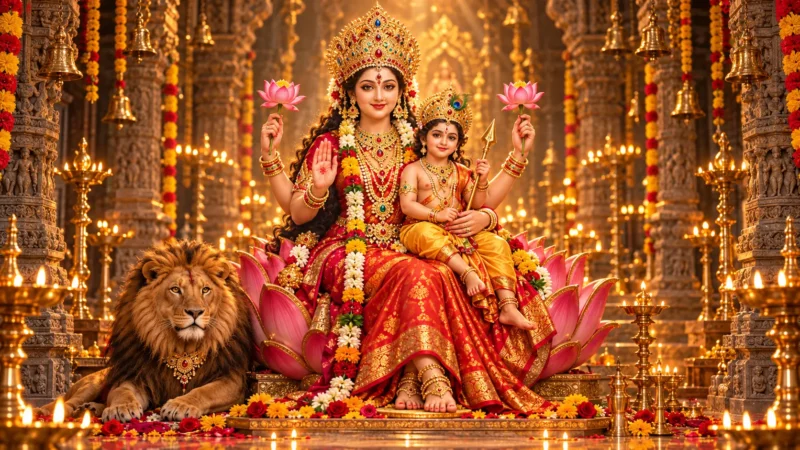
On the fifth morning of Navratri, a mother lights a lamp before an image of a goddess with a child in her lap, and prays not for herself, but for the people she loves. This is the tenderness you invite with Skandamata Puja.
Also Read: Kalabhirava Ashtakam: Lyrics, Meaning And Benefits
What is Skandamata Puja?
Suggested Puja
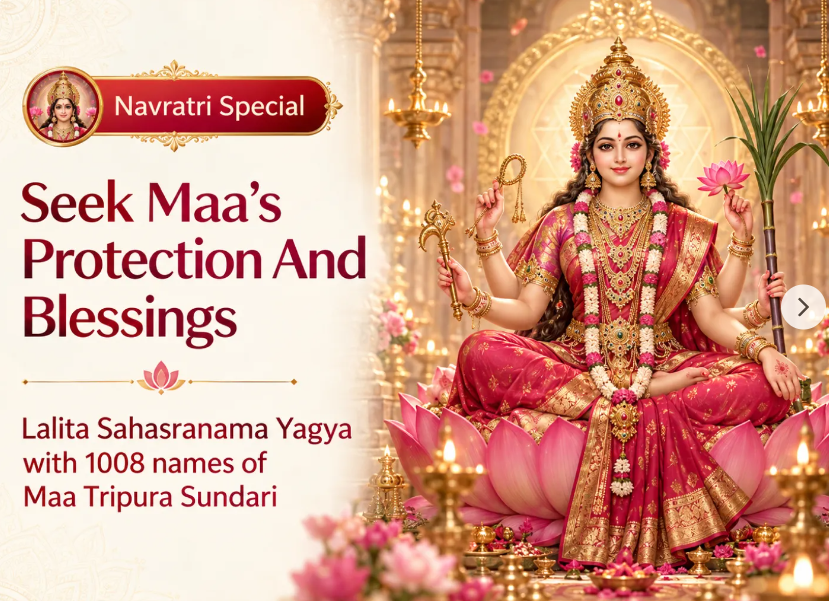
Lalita Sahasranama Yagya with 1008 names of Maa Tripura Sundari
Seek The Blessings Of Maa Shakti & Bring Positivity Into Life
Skandamata Puja is the worship of Maa Skandamata, the fifth of the nine forms of Goddess Durga, on Day 5 of Navratri. The name joins Skanda, another name for Lord Kartikeya, with Mata, meaning mother.
She is Parvati in her motherly form, shown seated on a lotus with baby Skanda in her lap, which is why she is also called Padmasana Devi. Her four arms hold two lotuses, cradle her son and offer the abhaya mudra of fearlessness, and a lion rests beneath her.
Kartikeya grew up to lead the divine army against the demon Tarakasura, and tradition says that worshipping the mother also honours the son. She blesses the Vishuddha (throat) chakra.
Why Does Navratri Day 5 Belong to Maa Skandamata?
Devotees perform the puja on the fifth day of Navratri for these main reasons.
- She Follows Kushmanda: After the creation and warmth of Day 4, Day 5 brings the nurturing care needed to sustain what has begun.
- A Day of Motherhood: The fifth day turns the spotlight to the mother’s love, protection and guidance.
- Panchami Tithi: Day 5 falls on Panchami, and some traditions also observe it as Lalita Panchami.
- Mercury and Wednesday: Tradition associates her with Mercury, the planet of mind and speech.
- Vishuddha Chakra: Tradition links the throat chakra with this day, which makes it a good time to pray for clarity and honest expression.
- Skanda Together with His Mother: Her worship includes Lord Kartikeya, so devotees honour both on this day.
Why is Performing Skandamata Puja Important?
Maa Skandamata is the divine mother who nurtures and protects, so devotees turn to her for care, courage and clarity. Tradition holds that her worship brings blessings in many areas, not just one.
Motherhood and the Wellbeing of Children
Maa Skandamata represents the ideal mother, and devotees traditionally perform her puja for children’s health, safety and happiness. Parents and expecting couples often seek her blessings.
Families praying for a child also choose this puja. It offers spiritual support and does not replace medical care.
Wisdom, Speech and Clear Communication
Her link with the Vishuddha chakra is why devotees pray to her for clarity of thought and confidence in speech. Tradition associates her with learning and knowledge.
Students, teachers and professionals who speak or write for a living often seek her blessings. Devotees believe a calm mind helps them express themselves with ease.
Protection and Fearlessness
Skandamata’s raised hand in abhaya mudra offers reassurance, and her lion shows quiet strength. Devotees believe she protects them the way a mother protects a child.
Those who feel anxious about the future turn to her for courage. Devotees traditionally seek her blessings to move ahead without fear.
Family Harmony and Peace at Home
The image of mother and child at the heart of her form stands for love and togetherness. Devotees believe that praying to her brings warmth and understanding into the household.
The whole family can do this meaningful puja together. Devotees traditionally seek her blessings for a peaceful, supportive home.
Prosperity and Fulfilment of Sincere Wishes
Devotees believe that Skandamata grants prosperity to those who worship her with a pure heart and helps their sincere wishes move towards fulfilment. Because her worship includes Lord Skanda, devotees see the blessing as double.
Those hoping for stability in work and home life often choose this puja. Devotees believe her blessings reward steady effort and faith.
Peace of Mind and Emotional Calm
Her seat on the lotus stands for purity and a mind that stays undisturbed. Devotees pray to her when worries, confusion or restlessness feel heavy.
Devotees believe a sankalp on Day 5 settles the mind through the middle of Navratri. They traditionally seek her blessings for compassion and inner calm.
Who Should Consider Skandamata Puja?
As a devotee, you may want to perform Skandamata puja if you:
- Want to pray for the health and happiness of your children
- Are expecting a child or hoping to start a family
- Are a student, teacher or professional who wants clarity in speech and thought
- Feel anxious, indecisive or low on confidence
- Have a weak or afflicted Mercury in your birth chart
- Wish to bring peace and togetherness into your home
- Want to begin the second half of Navratri with a sankalp of protection and care
What is the Astrological Significance of Skandamata Puja?
In Vedic astrology, each Navratri form is traditionally linked with a planet. Maa Skandamata is associated with Mercury (Budh), the planet of intellect, speech and communication.
- Mercury (Budh): Mercury governs the mind, learning and expression. Devotees with a weak or afflicted Mercury, often seen as confusion, poor concentration or communication trouble, traditionally turn to Maa Skandamata.
- Wednesday: Wednesday is ruled by Mercury, so it is considered favourable for her worship.
- Gemini and Virgo (Mithuna and Kanya Rashi): Both signs are ruled by Mercury, and people of these signs often feel a natural pull towards her puja.
- Mercury-ruled Nakshatras: Ashlesha, Jyeshtha and Revati are ruled by Mercury. There is no scripturally fixed nakshatra for Maa Skandamata, but devotees born under these stars often choose her puja to strengthen Mercury’s influence.
- Jupiter (Guru): In Vedic astrology, Jupiter is the karaka, or significator, of children. This is one reason prayers for children’s well-being are linked with Maa Skandamata’s day.
- Vishuddha Chakra: Linked with the space element, it relates to speech, expression and truth.
Who Can Perform Skandamata Puja as a Remedy?
- Those with a weak or afflicted Mercury, or those running a Budh Mahadasha or Antardasha
- People facing confusion, poor focus or difficulty in expressing themselves
- Students and professionals in teaching, writing, speaking or business
- Parents and couples praying for children and family well-being
Skandamata Puja Samagri and Simple Vidhi
Whether you perform the puja at home or follow it along with a pandit, having the right samagri and a simple, mindful vidhi helps you stay focused on your prayer.
Samagri
Bananas (her traditional bhog), kheer or milk-based sweets, lotus or white flowers, kumkum, akshat (rice), incense, a diya, a japa mala, an image of Maa Skandamata with baby Skanda, and a kalash filled with water.
Simple Vidhi
Bathe early and wear clean clothes. Set up an image of Maa Skandamata with Skanda in her lap, light a lamp, offer flowers and bananas, and chant her mantra with a mala. Offer a prayer to Lord Kartikeya as well, conclude with aarti, and share the prasad with your family, especially children.
Maa Skandamata Puja Mantra, Stuti and Dhyana
The following are some of the popular chants recited to please Maa Skandamata.
1. Maa Skandamata Mantra
ॐ देवी स्कन्दमातायै नमः॥
Om Devi Skandamatayai Namah॥
2. Maa Skandamata Stuti
या देवी सर्वभूतेषु माँ स्कन्दमाता रूपेण संस्थिता।
नमस्तस्यै नमस्तस्यै नमस्तस्यै नमो नमः॥
Ya Devi Sarvabhuteshu Maa Skandamata Rupena Samsthita।
Namastasyai Namastasyai Namastasyai Namo Namah॥
3. Maa Skandamata Prarthana
सिंहासनगता नित्यं पद्माश्रितकरद्वया।
शुभदास्तु सदा देवी स्कन्दमाता यशस्विनी॥
Simhasanagata Nityam Padmashritakaradvaya।
Shubhadastu Sada Devi Skandamata Yashasvini॥
4. Maa Skandamata Dhyana
वन्दे वाञ्छित कामार्थे चन्द्रार्धकृतशेखराम्।
सिंहारूढ़ा चतुर्भुजा स्कन्दमाता यशस्विनीम्॥
धवलवर्णा विशुद्ध चक्रस्थितां पञ्चम दुर्गा त्रिनेत्राम्।
अभय पद्म युग्म करां दक्षिण उरू पुत्रधराम्॥
Vande Vanchhita Kamartham Chandrardhakritashekharam।
Simharudha Chaturbhuja Skandamata Yashasvinim॥
Dhavalavarna Vishuddha Chakrasthitam Panchama Durga Trinetram।
Abhaya Padma Yugma Karam Dakshina Uru Putradharam॥
Conclusion
Maa Skandamata shows that love and strength are not opposites. The same mother who cradles her child with tenderness also stands with a lion beneath her, ready to protect. Make the fifth day of Navratri a day of care, clarity and courage, and let her blessings warm your home. Jai Maa Skandamata!