On the third day of Navratri, devotees worship Mata Chandraghanta, the third form of Navadurga. Courageous yet gentle, she is believed to remove fear, protect her devotees and bring peace and harmony into life.
Also Read: The Powers Of Maa Baglamukhi
Who is Goddess Chandraghanta?
Mata Chandraghanta is the married form of Goddess Parvati. After her marriage to Lord Shiva, Parvati adorned her forehead with a crescent moon shaped like a bell. Chandra means moon and ghanta means bell, and that is how the goddess received her name.
Symbolism of Mata Chandraghanta’s Form
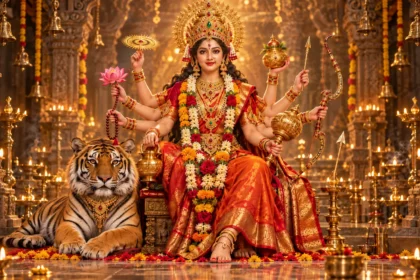
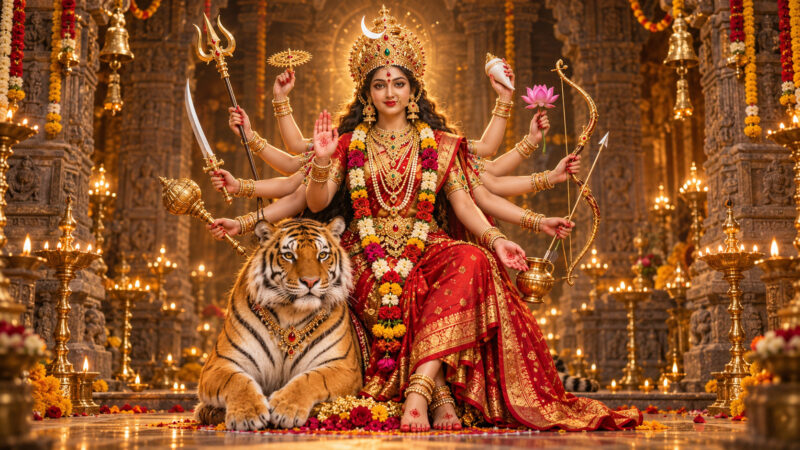
She is portrayed with a golden complexion, ten hands and a third eye. Her hands carry weapons and sacred objects, and she rides a tiger. Despite her readiness for battle, her face remains calm and gentle.
-
The Crescent Moon and Bell
The crescent moon on her forehead is shaped like a bell, which gives her the name Chandraghanta. The moon stands for calm and peace of mind. The bell is believed to drive away negative forces with its sound.
-
Ten Hands and Divine Weapons
Her ten hands carry weapons and sacred objects, showing that she is always ready to protect her devotees. They also stand for power in every direction. One hand is raised in blessing, showing that her strength comes with kindness.
-
The Third Eye
Her third eye represents wisdom and the power to see the truth. It is also seen as the power that destroys evil. Devotees believe nothing can be hidden from her watchful gaze.
-
The Tiger as Her Mount
The tiger symbolises courage and fearlessness. By riding it with ease, she shows complete control over fear and anger. Devotees pray to her to find the same steady courage in life.
-
Her Golden Complexion
Her golden glow stands for light, purity and divine energy. It also represents prosperity and a warm, welcoming nature. Her golden form reminds devotees that she is both powerful and gentle.
Why Should We Worship Chandraghanta Mata?
Devotees turn to Maa Chandraghanta because she offers both strength and serenity. Her worship is believed to bring the following blessings.
-
Courage and Fearlessness
Maa Chandraghanta is shown in a warrior form, with ten hands carrying weapons and a tiger as her mount. Devotees believe that remembering her helps them face fear and uncertainty with confidence.
-
Peace of Mind
She is fierce towards evil but gentle with her devotees, and is known as the goddess of peace and forgiveness. Many pray to her when anxious or restless.
-
Protection from Negativity and Obstacles
The crescent moon on her forehead resembles a bell. According to tradition, its sound drives away negative forces and evil. Devotees believe her divine bell clears harmful energies and removes obstacles from their lives.
-
Inner Strength and Confidence
Worship on the third day is associated with the Manipura (solar plexus) chakra, linked to willpower, confidence and decision-making. Devotees believe that sincere worship of Maa Chandraghanta helps awaken these qualities.
-
Harmony in Relationships
Maa Chandraghanta is the form Parvati took after her marriage to Lord Shiva, so she symbolises a loving and balanced union. Couples pray for understanding, and unmarried devotees seek her blessings for a happy married life.
What is the Astrological Significance of Worshipping Chandraghanta Mata?
-
Venus (Shukra)
In the traditional association of Navadurga with the planets, Maa Chandraghanta is linked with Venus. Venus governs love, beauty, harmony, marriage and material comforts. When Venus is weak in a horoscope, devotees turn to her to strengthen its positive qualities.
-
Manipura Chakra Activation
Worship on the third day of Navratri is associated with the Manipura (solar plexus) chakra. This energy centre is linked with willpower, confidence and decision-making. Devotees believe that sincere worship helps awaken these qualities and brings clarity and strength.
-
Moon (Chandra)
Her name comes from the crescent moon she wears on her forehead, and in astrology the Moon represents the mind, emotions and inner peace. A strong, steady Moon is believed to bring a calm and balanced mind. Devotees therefore pray to her for relief from worry, restlessness and emotional ups and downs.
Who May Benefit From Pleasing Mata Chandraghanta?
Maa Chandraghanta is named in the Devi Kavacha, a protective hymn traditionally recited alongside the Devi Mahatmya (Durga Saptashati) of the Markandeya Purana. In this verse, Lord Brahma names her as the third of the Navadurga and reveals these names to protect all beings. Devotees from all walks of life therefore seek her blessings.
- Those with a weak or afflicted Moon: Devotees facing Moon-related troubles in their horoscope
- Those running a Chandra Mahadasha or Antardasha: People seeking steadiness during Moon-ruled periods
- People facing mental stress or anxiety: Devotees who feel restless, worried or overwhelmed
- Those with disturbed sleep: People seeking calm and rest (please see a doctor if it continues)
- Those going through Sade Sati: Devotees seeking emotional steadiness, since the Moon sign is the reference point
- Families praying for peace at home: Households seeking harmony and a settled start to the year
Chandraghanta Puja Mantra
Mantras are the heart of Maa Chandraghanta’s worship on the third day of Navratri. Here are four traditional mantras, from the simplest to the more detailed, so devotees can choose according to their time and comfort.
1. Chandraghanta Mata Mantra
ॐ देवी चन्द्रघण्टायै नमः
Om Devi Chandraghantayai Namah
Meaning: “I bow to Goddess Chandraghanta.”
Devotees traditionally chant this mantra 108 times on Day 3 of Navratri, both in the morning and evening, to cultivate courage and a calm mind. It is the easiest mantra to follow, so anyone can chant it.
2. Maa Chandraghanta Beej Mantra
ऐं श्रीं शक्त्यै नमः
Aim Shreem Shaktyai Namah
Meaning: “Salutations to Shakti.” The seed sounds Aim and Shreem are traditionally linked with wisdom and prosperity.
Devotees chant this short mantra on the third day, with a calm mind and steady breath. They consider this mantra suitable for those who want a more focused practice.
3. Mata Chandraghanta Dhyana Mantra
पिण्डजप्रवरारूढा चण्डकोपास्त्रकैर्युता ।
प्रसादं तनुते मह्यं चन्द्रघण्टेति विश्रुता ॥
Pindaja Pravararudha Chandakopastrakairyuta |
Prasadam Tanute Mahyam Chandraghanteti Vishruta ||
Meaning: “May the Goddess known as Chandraghanta, seated on an excellent mount and bearing fierce weapons, grant me her grace.”
Devotees recite this verse while meditating on the goddess’s form, usually before the main puja. They visualise her golden form and crescent moon while reciting the verse, which tradition says helps them cultivate humility and fearlessness.
4. Mata Chandraghanta Stuti
या देवी सर्वभूतेषु चन्द्रघण्टारूपेण संस्थिता ।
नमस्तस्यै नमस्तस्यै नमस्तस्यै नमो नमः ॥
Ya Devi Sarvabhuteshu Chandraghanta Rupena Samsthita |
Namastasyai Namastasyai Namastasyai Namo Namah ||
Meaning: “To the Goddess who dwells in all beings in the form of Chandraghanta, I bow to her again and again.”
This is the same stuti for every form of Durga, with the goddess’s name replaced. Devotees recite it at the end of the puja as a closing prayer of surrender, often three or more times.
Conclusion
Mata Chandraghanta shows that strength and gentleness can live together. Worshipping her on Day 3 of Navratri invites courage, peace and harmony into life. May her grace protect every devotee and bless them with fearlessness, happiness and a balanced home.