Politicians, top lawyers, and powerful business figures – people who operate in high-risk worlds – they all seek the blessings of Bagalamukhi Devi. Hence, the pull of the Mata Baglamukhi Puja is perhaps the most powerful when life puts you in the middle of a battle you did not choose.
Who is Bagalamukhi Devi?
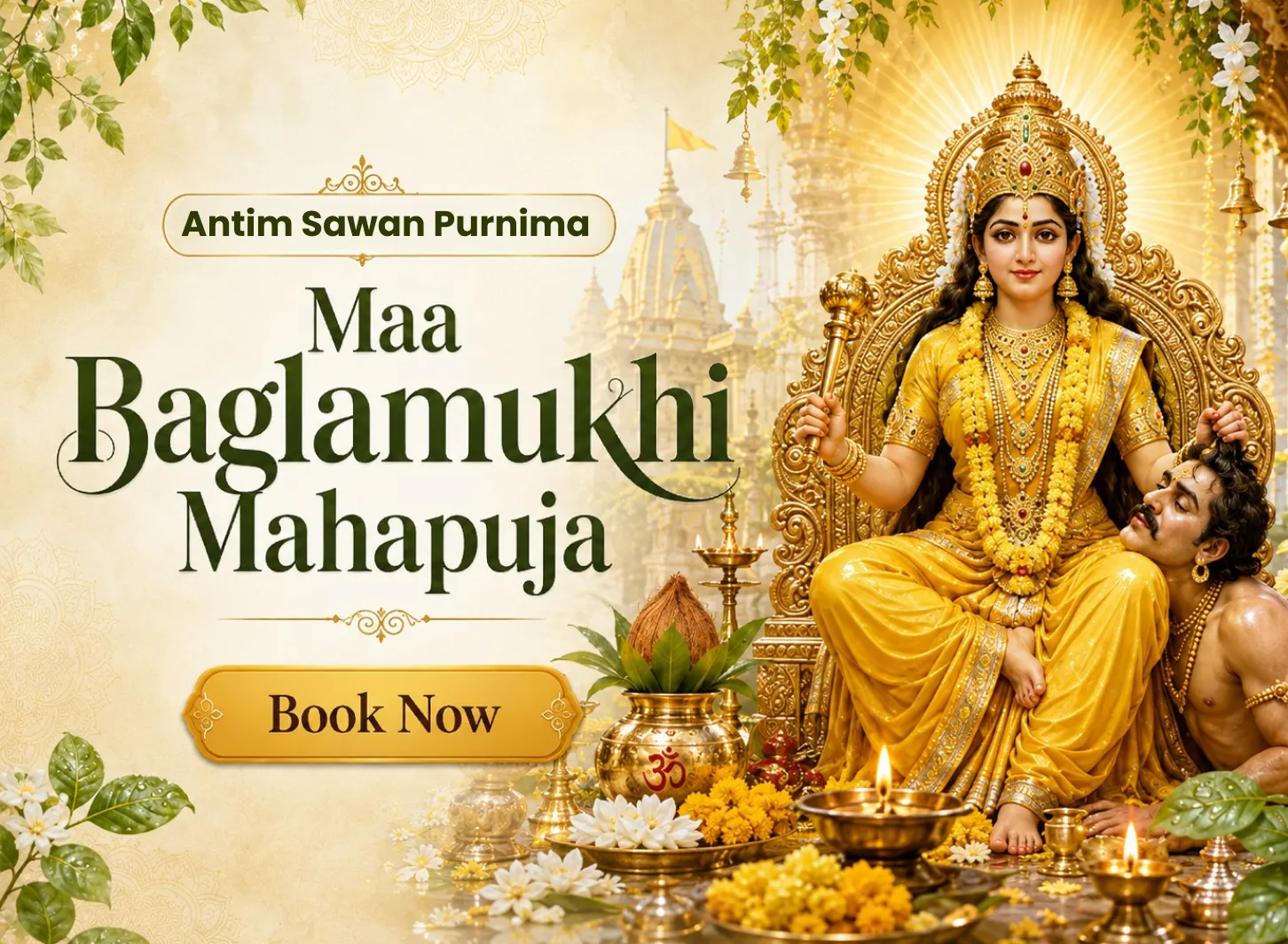
Maa Bagalamukhi is the eighth of the ten Mahavidyas. The name Baglamukhi comes from Vagla (bridle/rein) and Mukhi (face), meaning “She who holds the power”. The devi is placed on the same platform as Lord Brahma’s weapon, i.e. speech. Quite popular for Mahavidya Puja, she is called Bogola Maa in Bengal and Assam.
Bagalamukhi Devi, a form of Lord Parvati, is the goddess of supreme knowledge, wisdom, and ultimate superior intellectual speech.
She represents the point where words meet the highest form of wisdom. And from that union comes an extraordinary gift – “Wordplay so superior, it can paralyse your enemies”.
The goddess is also popularly called Sthambini Devi and Brahmastra Roopini. Moreover, depicting her great powers, the Vedic texts mention that she has 108 different names in total.
Also Read: Why Kaal Sarp Dosh Puja Is Important?
The Significance of Maa Bagalamukhi Puja
Baglamukhi Puja significance lies in its ability to benefit on multiple levels simultaneously – spiritual, mental, and situational. Hence, this is not a simple prayer; it is an occult invocation that channels the goddess’s controlling power directly into your circumstances.
The Baglamukhi puja is especially significant for:
- Stambhana – paralysing enemies, rivals, and negative forces at their source
- Vachan Siddhi – gaining power and authority in speech
- Raksha (Protection) – creating an armour against black magic, evil eye, and deliberate harm
- Vijaya (Victory) – turning the tide in legal cases, business disputes, and power struggles
- Graha Shanti – pacifying malefic planetary influences, particularly Mars (Mangal)
The Appearance of Baglamukhi Goddess
The appearance of Mata Baglamukhi carries a deep lesson: with cleverly crafted words, one can either create or destroy the universe, and Maa Bagalamukhi is its master.
Complexion And Attire
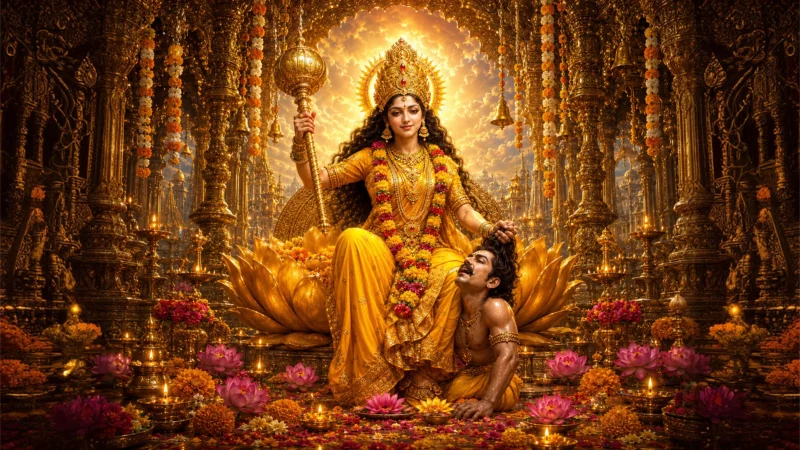
Bagalamukhi Devi radiates a golden yellow complexion – shining, powerful, and impossible to ignore. So, that golden glow is not just beauty; it is wisdom, purity, and divine energy made visible.
Moreover, she dresses entirely in yellow – a yellow saree, yellow jewellery, and yellow flower garlands. This is why she is lovingly called Pitambari Devi – the goddess who wears the colour of the sun.
Four Arms
Bagalamukhi Devi is typically shown with four arms, a common feature in a Hindu Bagalamukhi temple. Her hands bless, protect, destroy evil, and offer wisdom, all at once.
- Left Hand: She pulls the tongue of a demon with her left hand. This silences malicious speech and false accusations at their very source.
- Right Hand: She raises her right hand, holding a club, the weapon of justice. Thus, this symbolises her power to crush evil and deliver swift victory.
- Third Eye & Crescent Moon: She has three eyes and a yellow crescent moon on her forehead. The three eyes see through deception and illusion. The crescent moon connects her to Shiva’s energy.
- Crane Head (Occasionally): She is sometimes depicted with the head of a crane – or riding one. The crane stands motionless until the perfect moment, then strikes with precision (Stambhana).
Elements Depicting the Role of Bagalamukhi Goddess
Every aspect of Maa Baglamukhi’s divine form carries meaning, from the creature she rides to the weapon she wields.
Hence, the iconography (image) of Bagalamukhi goddess is rich with symbols, each one representing her role and the energies she governs:
- The Crane: Bagalamukhi Devi’s vahana or vehicle is the crane, symbolising grace, patience, and mastery over time. The crane also represents her divine ability to paralyse enemies and control the movement of life itself.
- The Club: She is shown holding a club (gada), the weapon of justice and power. The club, thus, symbolises her ability to crush evil forces and bring victory and peace to her devotees.
- Bridle: Derived from Vagla, she represents her power to control and restrict all harmful forces.
- The Tongue: She pulls the demon’s tongue, symbolising her power to silence malicious speech and intent.
- Third Eye: Some depictions also show her third eye, representing divine vision and the ability to perceive truth beyond the physical.
Symbolism Behind Colour, Posture & Mudras of Mata Baglamukhi
The Colour, Posture and Mudras of Bagalamukhi Devi also carry deep symbolism, reflecting further what the goddess signifies and what pleases her.
Colour – The Power of Yellow
Yellow is not only the goddess’s favourite colour but also her energy made visible. It is her radiance, supreme intellect, divine power, and ultimate wisdom.
This is why all offerings in her puja, flowers, sweets, cloth, rice, are yellow. When you dress in yellow to worship her, you align yourself with her frequency and please her more.
Posture – The Throne of Divine Authority
Bagalamukhi Devi is depicted seated in a royal posture on a golden throne with a dead body as her cushion. The throne signals her supreme control over both the material and spiritual realms.
The dead body beneath her is not dreadful; it is deeply symbolic, representing her absolute victory over ego, death, and all that is inert. Her posture conveys love to her devotees; she sits in authority, yet ready to protect and guide.
Mudras – Hand Poses That Bless and Destroy
Her two hands carry two opposite but complementary energies. Together, these mudras make her complete: she destroys what harms you and gives you what you need.
- Abhaya Mudra: This gesture of the devi symbolises protection, offering devotees fearlessness.
- Varada Mudra: This is a gesture of boon-granting, symbolising her readiness to offer blessings to her beloved devotees.
Baglamukhi Mata History: Great Legends of the Devi
The story of Baglamukhi Mata is not one legend; it is many. Therefore, each tale reveals a different dimension of her power and the divine role she plays across ages.
The Storm in Satya Yuga: The Story of Baglamukhi Mata
In the Satya Yuga, once a massive storm arose, so violent that it threatened to destroy all life on Earth. That is, crops, animals, humans – everything was being consumed. Lord Vishnu, witnessing the chaos, meditated at Haridra Sarovar to save the universe.
Pleased by Lord Vishnu, Goddess Parvati appeared as Bagalamukhi Devi. That is, she rose from the Haridra Sarovara, the sacred golden lake in the Saurashtra district of Gujarat in modern-day, and absorbed the storm entirely into herself.
- Veer Ratri: In the Baglamukhi Mata history, the night of her manifestation was called Veer Ratri – a Tuesday falling on Chaturdashi – and it remains sacred in her worship to this day.
- Stambhana: The goddess does not fight the storm with equal force. She absorbs it, stills it, ends it at its source. This supreme power of stillness and paralysis is called Stambhana, and thus, Mata Baglamukhi is its absolute image.
The Demon Madan and the Power of Speech
Once, a demon named Madan was granted the boon of Vak Siddhi – whatever he spoke would come true. But he abused this power mercilessly, spreading fear, destruction, and death through his words alone. The gods, unable to stop him, turned to Maa Baglamukhi in desperation.
She interfered swiftly, grabbing Madan’s tongue and paralysing him completely. As a result, his words lost all power. His reign of terror ended instantly. This story reveals her greatest teaching: when negativity is silenced at its root, its power dissolves entirely.
Sacred Temples of Baglamukhi Goddess
Across India and beyond, Mata Baglamukhi temple serve as powerful centres of intense energy, drawing devotees worldwide. The popular Bagalamukhi temple are as follows:
- Maa Baglamukhi Dham Mandir, Ujjain, Madhya Pradesh:
Maa Baglamukhi Dham Mandir, Ujjain, Madhya Pradesh, is a powerful Shakti shrine. Here, devotees seek the goddess’s blessings to overcome enemies, remove obstacles, and have even noticed their wishes come true after attending sacred rituals.
- Baglamukhi Temple Kangra, Himachal Pradesh:
The Baglamukhi Temple Kangra, is one of the most ancient shrines dedicated to her. It draws a constant stream of devotees, particularly those fighting legal battles and professional conflicts.
- Bankhandi Temple, Himachal Pradesh:
One of the most visited and powerful Bagalamukhi temples in northern India. Its energy is considered especially powerful for stambhana rituals and protection from enemies.
- Baglamukhi Mata Mandir Nalkheda, Madhya Pradesh
The Baglamukhi Mata Mandir Nalkheda is a supreme seat rooted in ancient lineages. Thousands gather here on Tuesdays and during Navratri for her protection and grace.
- Datia, Madhya Pradesh
The Datia shrine is deeply embedded in the Hindu tradition of central India. It is especially significant during Navratri, drawing sadhaks from across the country.
- Hoshiarpur, Punjab
Another significant temple where devotees seek her blessings for victory in conflicts and legal matters. Its tradition of worship is continuous and unbroken for centuries.
- Kamakhya Temple, Guwahati, Assam
One of the most powerful Shakti peethas in India, Kamakhya Temple, though popular for Kamakhya Maa, is also one of the spiritual centres of Bogola Maa Mahavidya Puja. She is worshipped there as part of the broader occult tradition.
Festivals Dedicated to Maa Bagalamukhi
Mata Baglamukhi is worshipped throughout the year, but certain days and festivals carry a far greater spiritual significance than others.
Baglamukhi Jayanti
Baglamukhi Jayanti is celebrated as the day of her divine manifestation, her avtaran divas. Moreover, this sacred festival falls on Vaisakh Shukla Ashtami (the 8th day of the bright fortnight of the Vaishakh month, April-May).
Devotees observe fasts, perform special pujas, offer two knots of turmeric, and chant her mantra in large numbers. This puja on Jayanti is believed to be exponentially more powerful than on any ordinary day.
Maa Bagalamukhi Puja in Navratri
Navratri, the nine nights of the goddess, is one of the most auspicious periods for Mata Baglamukhi’s worship. Her energy is at its most accessible during this time.
Hence, during Navaratri, devotees also perform the extended Baglamukhi path, havan, and mantra japa throughout the nine days for maximum grace.
Maa Bagalamukhi Puja in Gupt Navratri
Gupt Navratri is considered even more powerful for occult goddesses like Baglamukhi Devi. It occurs twice a year, in Magh (January – February) and Ashadh (June – July).
These are the hidden nine nights, traditionally observed by serious occult practitioners and sadhaks. Worship during Gupt Navratri is believed to offer fast and powerful results.
Maa Bagalamukhi Puja During Shravan
Shravan Maas, the holy month of Lord Shiva, holds deep significance for Baglamukhi Devi as well, given her inseparable connection to Shiva as his Shakti.
Devotees perform the Bagalamukhi Devi puja on every Monday of Shravan. It is especially for devotees seeking relief from chronic obstacles and health issues.
Maa Bagalamukhi Puja in MahaShivaratri
MahaShivaratri, the great night of Shiva, is one of the most powerful nights in the Hindu calendar for occult worship. Since Bagalamukhi Devi is the Shakti of Shiva, this night holds special significance for her invocation as well.
Performing her puja on MahaShivaratri is believed to invoke the combined blessings of both Shiva and Shakti simultaneously. Devotees who perform the Baglamukhi path after the MahaShivaratri aarti are said to receive her swiftest and most powerful grace.
Best Days and Times to Perform Baglamukhi Puja
Timing matters deeply in occult worship; the right day and hour amplify the puja’s power many times over. Here is when her worship offers maximum results.
Best Days For Bagalamukhi Devi Puja
- Tuesday (Mangalwar): It is the most auspicious day. Also, Mars (Mangal) is dear to Mata, and she herself manifested on a Tuesday (Veer Ratri).
- Thursday (Guruvar): It is highly auspicious. Chanting her mantra 108 times every Thursday builds steady spiritual protection.
- Ashtami (8th day) and Chaturdashi (14th day) of Krishna Paksha: These are powerful lunar phases for invoking fierce deities and protection rituals
- Baglamukhi Jayanti: It is the most powerful day of the year, on Vaisakh Shukla Ashtami (April-May).
- Navratri and Gupt Navratri: These are periods of intensified Shakti energy, ideal for her worship.
Best Time For Bagalamukhi Devi Puja
The hour of worship is as important as the day. These are the windows when her divine energy is most rewarding.
- Brahma Muhurta (3:30 AM – 5:30 AM): The most auspicious time for any spiritual practice; The mind is fresh, the atmosphere is still, and the divine connection is at its deepest.
- Nishitha Kala (11 PM – 2 AM): As a Mahavidya, she is especially invoked during night hours; the most powerful time for her occult sadhana.
- Siddha Muhurta: The exact Siddha Prapti Muhurta (when planets are perfectly aligned) is ideally calculated based on the devotee’s birth chart and the specific purpose of the ritual.
What Should You Perform Maa Bagalamukhi Puja?
Well, one popular question that people keep asking is – What are the benefits of Maa Bagalamukhi Puja? Here is your answer.
1. Victory Over Enemies
Whether a rival at work, an opponent in court, or someone working against you through jealousy, the Bagalamukhi goddess paralyses their efforts and turns the tide in your favour. This is especially achieved through a list of Baglamukhi Mantra.
Also, read the powerful Bagalamukhi Mata Mool Beej Mantra
2. Protection from Black Magic & Evil Eye
As Brahmastra Roopini, Bogola Maa is one of the most powerful shields against tantra, black magic, nazar, and deliberately sent negative energies. Her puja creates an invisible armour around the devotee.
3. Success in Legal Matters
Lawyers and litigants have sought her blessings for centuries – and for good reason. She governs the stambhana (control) of the opposing party’s speech and arguments. Truth rises; false accusations fall.
4. Control Over Harmful Speech
Enemies who defame, spread false rumours, or cause damage through words – their power comes directly under her rein. Mata Baglamukhi is, after all, the goddess who pulls out the demon’s tongue.
5. Clearing Deep-Rooted Obstacles
Some blocks in your life are karmic in nature, not caused by enemies at all, but by past karmic debts. The Baglamukhi path – performed with proper vidhi – dissolves these too.
6. Mental Strength & Fearlessness
Worshipping the Bagalamukhi goddess dissolves fear, anxiety, and confusion from within. Sthambini Devi does not just remove outer threats – she makes you unshakeable at your core.
Note: Unlike Baglamukhi Mantras, which do not require much time during Bagalamukhi Devi Puja, devotees can also go for her equally powerful Chalisa, Stotram, and Aarti.
Shri Baglamukhi Chalisa In English
Here are your Bagalamukhi Devi Chalisa lyrics in English that you must complete in one sitting for maximum benefits from Bagalamukhi Puja.
।। Doha ।।
Sir Navai Baglamukhi Likhun Chalisa Aaj |
Kripa Karahu Mopar Sada Pooran Ho Mam Kaaj॥
।। Chaupai ।।
Jai Jai Jai Shri Bagla Mata |
Adishakti Sab Jag Ki Trata॥ 1 ॥
Bagla Sam Tab Aanan Mata |
Ehi Te Bhayu Naam Vikhyata॥ 2 ॥
Shashi Lalat Kundal Chhavi Nyari |
Asatuti Karahin Dev Nar Nari॥ 3 ॥
Pitvasan Tan Par Tav Rajai |
Hathhin Mudgar Gada Virajai॥ 4 ॥
Tin Nayan Gal Champak Mala |
Amit Tej Prakatat Hai Bhala॥ 5 ॥
Ratna Jatit Sinhasan Sohai |
Shobha Nirakhi Sakal Jan Mohai॥ 6 ॥
Asan Pitavarn Maharani |
Bhaktan Ki Tum Ho Varadani॥ 7 ॥
Pitabhushan Pitahin Chandan |
Sur Nar Nag Karat Sab Vandan॥ 8 ॥
Ehi Vidhi Dhyan Hrday Mein Rakhai |
Ved Puran Sant As Bhakhai॥ 9 ॥
Ab Pooja Vidhi Karan Prakasha |
Jake Kiye Hot Dukh Nasha॥ 10 ॥
Prathamahin Pit Dhvaja Phaharavai |
Pitavasan Devi Pahiravai॥ 11 ॥
Kumkum Akshat Modak Besan |
Abir Gulal Supari Chandan॥ 12 ॥
Malya Haridra Aru Phal Pana |
Sabahin Chadhi Dharye Ur Dhyana॥ 13 ॥
Dhoop Dip Karpoor Ki Bati |
Prem Sahit Tab Karai Aarti॥ 14 ॥
Astuti Karai Hath Dou Jore |
Puravahu Matu Manorath More॥ 15 ॥
Matu Bhagati Tab Sab Sukh Khani |
Karhun Kripa Mopar Janjani॥ 16 ॥
Trividh Taap Sab Dukh Nashavahu |
Timir Mitkar Gyan Badhavahu॥ 17 ॥
Bar Bar Main Binavahun Tohin |
Aviral Bhagati Gyan Do Mohin॥ 18 ॥
Poojanant Mein Havan Karavai |
Sa Nar Manavanchhit Phal Pavai॥ 19 ॥
Sarshap Hom Karai Jo Koi |
Take Vash Sacharachar Hoi॥ 20 ॥
Til Tandul Sang Kshir Miravai |
Bhakti Prem Se Havan Karavai॥ 21 ॥
Dukh Daridra Vyapai Nahin Soi |
Nishchay Sukh Sampatti Sab Hoi॥ 22 ॥
Phool Ashok Havan Jo Karai |
Taake Grh Sukh Sampatti Bharai॥ 23 ॥
Phal Semar Ka Hom Karijai |
Nishchay Vako Ripu Sab Chhijai॥ 24 ॥
Guggul Ghrut Homai Jo Koi |
Tehi Ke Vash Mein Raja Hoi॥ 25 ॥
Guggul Til Sang Hom Karavai |
Tako Sakal Bandh Kat Javai॥ 26 ॥
Bilakshar Ka Path Jo Karahin |
Bij Mantra Tumharo Uchcharahin॥ 27 ॥
Ek Maas Nishi Jo Kar Japa |
Tehi Kar Mitat Sakal Santapa॥ 28 ॥
Ghar Ki Shuddh Bhoomi Jahan Hoi |
Sadhka Jaap Karai Tahan Soi॥ 29 ॥
Sei Ichchhit Phal Nishchay Pavai |
Yamai Nahin Kadu Sanshay Lavai॥ 30 ॥
Athava Tir Nadi Ke Jai |
Sadhak Jaap Karai Man Lai॥ 31 ॥
Das Sahasra Jap Karai Jo Koi |
Sak Kaaj Tehi Kar Sidhi Hoi॥ 32 ॥
Jaap Karai Jo Lakshahin Baara |
Takar Hoy Suyashavistara॥ 33 ॥
Jo Tav Naam Japai Man Lai |
Alpakal Mahan Ripuhin Nasai॥ 34 ॥
Saptaratri Jo Papahin Nama |
Vako Pooran Ho Sab Kama॥ 35 ॥
Nav Din Jaap Kare Jo Koi |
Vyadhi Rahit Takar Tan Hoi॥ 36 ॥
Dhyan Karai Jo Bandhya Nari |
Pavai Putradik Phal Chari॥ 37 ॥
Pratah Sayan Aru Madhyana |
Dhare Dhyan Hovaikalyana॥ 38 ॥
Kahan Lagi Mahima Kahaun Tihari |
Naam Sada Shubh Mangalkari॥ 39 ॥
Path Karai Jo Nitya Chalisa |
Tehi Par Kripa Karhin Gaurisha॥ 40 ॥
।। Doha ।।
Santasharan Ko Tanay Hoon |
Kulapati Mishr Sunam |
Haridvar Mandal Basoon |
Dham Haripur Gram॥ 1 ॥
Unnis Sau Pichanabe San Ki |
Shravan Shukla Maas |
Chalisa Rachana Kiyou |
Tav Charanan Ko Daas॥ 1 ॥
Maa Baglamukhi Stotram in English
Maa Baglamukhi Stotram in English, a 16-verse, equally important and powerful strota is given below. This can be performed while praying to Bagalamukhi Devi.
Here it starts:
Om brahmāstra-rupiṇī devī, mātā shrībagalāmukhī।
Chichchhiktirjnyāna-rupā cha, brahmānanda-pradāyinī ॥ 1 ॥
Mahā-vidyā mahā-lakṣhmī shrīmat -tripura-sundarī।
Bhuvaneshī jaganmātā, pārvatī sarva-mangalā ॥ 2 ॥
Lalitā bhairavī shāntā, annapūrṇā kuleshvarī।
Vārāhī chhinnamastā cha, tārā kālī sarasvatī ॥ 3 ॥
Jagat -pūjyā mahā-māyā, kāmeshī bhaga-mālinī।
Dakṣha-putrī shivāankasthā, shivarupā shivapriyā ॥ 4 ॥
Sarva-sampat-karī devī, sarva-lok vashankarī।
Veda-vidyā mahā-pūjyā, bhaktādveṣhī bhayankarī ॥ 5 ॥
Stambha-rupā stambhinī cha, duṣhṭa-stambhana-kāriṇī।
Bhakta-priyā mahā-bhogā, shrīvidyā lalitāmbikā ॥ 6 ॥
Menā-putrī shivānandā, mātangī bhuvaneshvarī।
Nārasianhī narendrā cha, nṛupārādhyā narottamā ॥ 7 ॥
Nāginī nāga-putrī cha, nagarāja-sutā umā।
Pītāmbarā pīta-puṣhpā cha, pīta-vastra-priyā shubhā ॥ 8 ॥
Pīta-gandha-priyā rāmā, pīta-ratnārchitā shivā।
Arddha-chandra-dharī devī, gadā-mud-gara-dhāriṇī ॥ 9 ॥
Sāvitrī tri-padā shuddhā, sadyo rāga-vivarddhinī।
Viṣhṇu-rupā jaganmohā, brahma-rupā hari-priyā ॥ 10 ॥
Rudra-rupā rudra-shaktiddinmayī bhakta-vatsalā।
Loka-mātā shivā sandhyā, shiva-pūjana-tatparā ॥ 11 ॥
Dhanādhyakṣhā dhaneshī cha, dharmadā dhanadā dhanā।
Chaṇḍa-darpa-harī devī, shumbhāsura-nivarhiṇī ॥ 12 ॥
Rāja-rājeshvarī devī, mahiṣhāsura-mardinī।
Madhu-kaiṭabha-hantrī cha, rakta-bīja-vināshinī ॥ 13 ॥
Dhūmrākṣha-daitya-hantrī cha, bhaṇḍāsura-vināshinī।
Reṇu-putrī mahā-māyā, bhrāmarī bhramarāmbikā ॥ 14 ॥
Jvālāmukhī bhadrakālī, bagalā shatra-unāshinī।
Indrāṇī indra-pūjyā cha, guha-mātā guṇeshvarī ॥ 15 ॥
Vajra-pāsha-dharā devī, jihvā-mud-gara-dhāriṇī।
Bhaktānandakarī devī, bagalā parameshvarī ॥ 16 ॥
Maa Baglamukhi Aarti in English
This is an easier yet intense impact of Bagalamukhi Devi Aarti in English, which pleases the goddess immensely and helps you combat every kind of tough situation.
Here it begins:
Jay Jay Shri Baglamukhi Mata,
Aarti Karahun Tumhari.
Jay Jay Shri Baglamukhi Mata,
Aarti Karahun Tumhari.
Peet Vasan Tan Par Tav Sohe,
Kundal Ki Chavi Nyari.
Kar Kamalon Me Mudgar Dhaare,
Astuti Karahin Sakal Nar Naari.
Jay Jay Shri Baglamukhi Mata ………..
Champak Maal Gale Lahrawe,
Sur Nar Muni Jay Jayati Uchari.
Jay Jay Shri Baglamukhi Mata …………..
Trividh Taap Miti Jaat Sakal Sab,
Bhakti Sada Tav Hai Sukhkaari.
Jay Jay Shri Baglamukhi Mata ……………
Paalan Harat Srijat Tum Jag Ko,
Sab Jiwan Ki Ho Rakhwari.
Jay Jay Shri Baglamukhi Mata ………..
Moh Nisha Me Bhramat Sakal Jan,
Karahu Hriday Mah, Tum Ujiyaari.
Jay Jay Shri Baglamukhi Mata ……….
Timir Nashawahu Gyan Badhawahu,
Ambe Tumahi Ho Asurari.
Jay Jay Shri Baglamukhi Mata …………..
Santan Ko Sukh Det Sada Hi,
Sab Jan Ki Tum Praan Pyari.
Jay Jay Shri Baglamukhi Mata ………..
Tav Charanan Jo Dhyan Lagawe,
Taako Ho Sab Bhav – Bhayhaari.
Jay Jay Shri Baglamukhi Mata ……………
Prem Sahit Jo Karahi Aarti,
Te Nar Mokshdhaam Adhikari.
Jay Jay Shri Baglamukhi Mata …………..
Conclusion: Maa Bagalamukhi Is the Word That Wins
When enemies, legal troubles, or deep-rooted obstacles cloud your path, no amount of effort alone is enough. Also, Mata Baglamukhi Puja channels her power directly into your life, neutralising what you cannot fight with ordinary means. Sometimes, the most powerful step you can take is a spiritual one. Jai Bagalamukhi Devi!