Bhai Dooj ends the five days of Diwali with a quiet, personal ritual. A sister applies a tilak, and a brother promises to look out for her. Before the tilak, families traditionally read or hear a katha. This guide begins with the vrat katha. Then it shares the other Bhai Dooj story versions that explain why the day matters.
Also Read: The Ultimate Powers Of Maa Baglamukhi
Bhai Dooj Vrat Katha (Yama Dwitiya Katha)
People also call the vrat katha the Yama Dwitiya Katha. One popular version of this Bhai Dooj story comes from the Sanat Kumara Samhita. In it, Rishi Valakhilya narrates the katha to a gathering of sages.
First, Valakhilya explains that the bright second day of Kartik is Yama Dwitiya. Devotees should remember and worship Yamraj, the god of death, on this day.
In ancient times, Yamuna, the river goddess and Yamraj’s sister, invited her brother home every day. She asked him to bring his friends and share a meal. However, Yamraj always gave the same reply. He would come tomorrow or the day after, but his duties left him no free time.
Yamraj Finally Accepted the Invite
One day, Yamuna invited him with real firmness, and Yamraj finally agreed. So, on that second day of Kartik, he freed every being from his noose. Then he set out with his attendants.
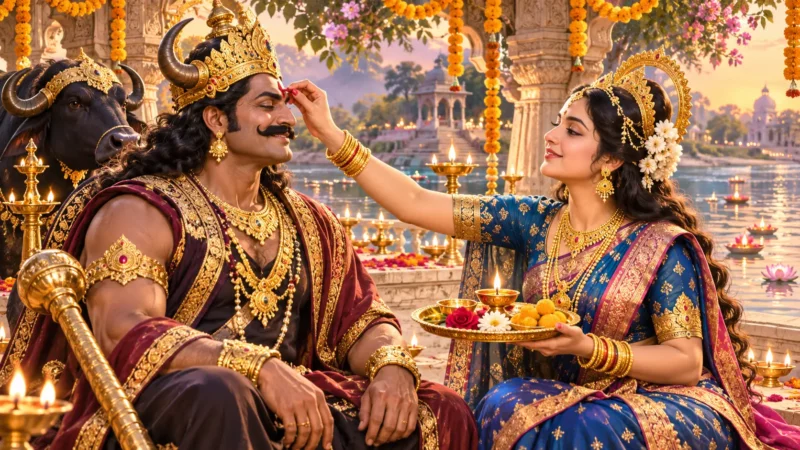
Next, Yamuna welcomed him with great love. She cooked many dishes, gave him fragrant oils and a bath, and dressed him in fine clothes. She also adorned him with sandal paste and garlands. After that, she served him a full meal on golden plates. In return, Yamraj honoured his sister with clothes and ornaments.
The Day Yamraj Grants the Boon
Pleased, Yamraj asked her to name any boon. Then Yamuna asked for two things. First, she wanted him to visit her every year on this day. Second, she wanted any man who eats at his sister’s hands to lose his fear of Yama’s noose. Moreover, that man would receive happiness and prosperity.
Yamraj granted the boon. He declared that a man should bathe in the Yamuna and offer water to the ancestors and gods. Then he should eat at his sister’s house. That man will never see the gates of Yama’s world.
In addition, Yamraj said that kings should release their prisoners on this day. Those prisoners can then eat at their sisters’ homes. Meanwhile, those who keep people imprisoned will answer to him.
Phal of Listening to the Bhai Dooj Katha
Rishi Valakhilya adds an important point about this Bhai Dooj story. If a man cannot reach his sister, listening to this katha gives him the same merit. He may be abroad, unaware of the rule, or otherwise unable to travel. Furthermore, tradition says a woman who feeds her brother and offers him paan will never become a widow. Her brother will also enjoy a long life.
The Yama–Yamuna Bhai Dooj Story in Popular Retelling
Most families know a slightly different version of the Bhai Dooj story from Hindi sources. This version adds some background. Yamraj and Yamuna were the children of Surya and his wife Sanjna. However, Sanjna could not bear Surya’s radiance. So she left a shadow form, Chhaya, to look after the children.
Yamuna remained deeply fond of her brother and visited him often. Yamraj, on the other hand, stayed too busy to return the visit. Finally, on Kartik Shukla Dwitiya, he arrived. Yamuna fed him, applied a tilak, and asked for the boon that began the festival.
In this retelling, she also asks that siblings who bathe in the Yamuna on this day escape Yamraj’s wrath. In addition, families traditionally light a four-wick lamp outside the house in the evening. They light the lamps inside afterwards.
Other Stories Behind Bhai Dooj
1. Krishna and Subhadra
After Krishna defeated the demon Narakasura, he went to Dwarka to see his sister Subhadra. She found her brother tired from battle and welcomed him home. Then she performed aarti, applied a tilak on his forehead, and offered him sweets and flowers. Krishna blessed her in return.
Many traditions see this tilak as the ancestor of the Bhai Dooj tilak. Thus, this Bhai Dooj story ties the festival to protection, victory of good, and reunion after struggle.
2. Mahavira, Nandivardhan and Sudarshana (Jain Tradition)
In Jain tradition, Diwali marks the nirvana of Lord Mahavira, the 24th Tirthankara. After his nirvana, his brother, King Nandivardhan, felt deep grief. However, his sister Sudarshana comforted him and looked after him.
Because of this, Jain accounts honour women on this day. This Bhai Dooj story highlights a sister’s role as a comforter. Therefore, many Jain communities also call the festival Bhai Beej.
3. Yamuna and Yamraj in Bengal’s Bhai Phonta
In Bengal, the Yama–Yamuna Bhai Dooj story lives on in the Bhai Phonta rhyme. As sisters apply sandalwood phonta on their brothers’ foreheads, they say that thorns rise at Yama’s door. In other words, the mark keeps death away from the brother. Some families also add curd to the sandalwood.
4. Chitragupta Puja
In some communities, especially business families, people also worship Lord Chitragupta on this day. He is the divine record-keeper who works under Yamraj. Chitragupta Puja falls on the same date. Therefore, the day carries both the sibling bond and the idea of honest accounts.
Bhai Dooj: One Festival, Many Names
The Bhai Dooj story travels far, so the festival has many names across India and beyond.
- Bhai Dooj / Bhaiya Dooj: North India
- Bhau Beej: Maharashtra, Goa, Karnataka and Gujarat
- Bhai Phonta: Bengal and parts of Odisha
- Bhai Tika: Nepal, with a seven-coloured tika
- Kija Puja: the Newar community
- Ningol Chakuba: Manipur
- Yama Dwitiya / Bhratri Dwitiya: the panchang and scriptures
Conclusion
Whether you follow the Yama–Yamuna katha, remember Krishna’s visit, or recall Sudarshana’s comfort, the message stays the same. Every Bhai Dooj story says one thing: show up for your sibling. If you cannot visit in person this year, a call or a video tilak works. Likewise, listening to the katha carries the same intention.