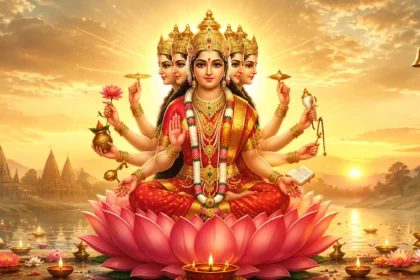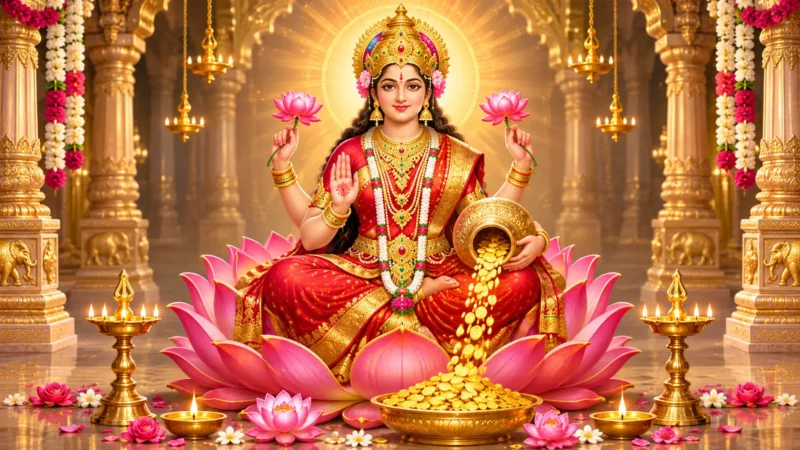
The Mahalaxmi Stotram is one of the most loved hymns to Goddess Lakshmi. People also call it the Mahalakshmi Ashtakam. According to the Padma Purana tradition, Lord Indra composed it in praise of Mahalakshmi.
This guide gives the complete Shri Mahalaxmi Stotram in Hindi. Next, you will find the Mahalaxmi Stotram lyrics in English for your ease and convenience, followed by the meaning of each verse and its significance.
Also Read: The Unlimited Powers Of Maa Baglamukhi
Shri Mahalaxmi Stotram Lyrics in Hindi
Suggested Puja
Lalita Sahasranama Yagya with 1008 names of Maa Tripura Sundari
Career Stability & Relief From Debts
॥ इन्द्र उवाच ॥
नमस्तेऽस्तु महामाये
श्रीपीठे सुरपूजिते
शङ्खचक्रगदाहस्ते
महालक्ष्मि नमोऽस्तु ते ||1||
नमस्ते गरुडारूढे
कोलासुरभयङ्करि
सर्वपापहरे देवि
महालक्ष्मि नमोऽस्तु ते ||2||
सर्वज्ञे सर्ववरदे
सर्वदुष्टभयङ्करि
सर्वदुःखहरे देवि
महालक्ष्मि नमोऽस्तु ते ||3||
सिद्धिबुद्धिप्रदे देवि
भुक्तिमुक्तिप्रदायिनि
मन्त्रमूर्ते सदा देवि
महालक्ष्मि नमोऽस्तु ते ||4||
आद्यन्तरहिते देवि
आद्यशक्तिमहेश्वरि
योगजे योगसम्भूते
महालक्ष्मि नमोऽस्तु ते ||5||
स्थूलसूक्ष्मे महारौद्रे
महाशक्तिमहोदरि
महापापहरे देवि
महालक्ष्मि नमोऽस्तु ते ||6||
पद्मासनस्थिते देवि
परब्रह्मस्वरूपिणि
परमेशि जगन्मातर्
महालक्ष्मि नमोऽस्तु ते ||7||
श्वेताम्बरधरे देवि
नानालङ्कारशोभिते
जगत्स्थिते जगन्मातर्
महालक्ष्मि नमोऽस्तु ते ||8||
॥ फलश्रुति ॥
महालक्ष्म्यष्टकं स्तोत्रं
यः पठेद्भक्तिमान्नरः
सर्वसिद्धिमवाप्नोति
राज्यं प्राप्नोति सर्वदा ||9||
एककाले पठेन्नित्यं
महापापविनाशनम्
द्विकालं यः पठेन्नित्यं
धनधान्यसमन्वितः ||10||
त्रिकालं यः पठेन्नित्यं
महाशत्रुविनाशनम्
महालक्ष्मीर्भवेन्नित्यं
प्रसन्ना वरदा शुभा ||11||
॥ इति इन्द्रकृतं श्रीमहालक्ष्म्यष्टकं सम्पूर्णम् ॥
Shri Mahalaxmi Stotram Lyrics in English
Indra Uvacha
Namastestu Mahamaye
Shree Pithe Sura Poojite
Shanka Chakra Gadha Haste
Maha Lakshmi Namoostute ||1||
Namastestu Garudarudhe
Kolasura Bhayankari
Sarva Papa Hare Devi
Maha Lakshmi Namoostute ||2||
Sarvajne Sarva Varade
Sarva Dushta Bhayankari
Sarva Duhkha Hare Devi
Maha Lakshmi Namoostute ||3||
Siddhi Buddhi Prade Devi
Bhukti Mukti Pradayini
Mantra Moorte Sada Devi
Maha Lakshmi Namoostute ||4||
Adyanta Rahite Devi
Adi Shakti Maheshwari
Yogaje Yoga Sambhute
Maha Lakshmi Namoostute ||5||
Sthula Sukshme Maha Raudre
Maha Shakti Mahodari
Maha Papa Hare Devi
Maha Lakshmi Namoostute ||6||
Padmasana Sthithe Devi
Parabrahma Swaroopini
Parameshi Jagan Mata
Maha Lakshmi Namoostute ||7||
Shwetambara Dhare Devi
Nanalankara Shobhite
Jagasthithe Jaganmata
Maha Lakshmi Namoostute ||8||
Phalashruti
Maha Lakshmyashtakam Stotram
Yah Patheth Bhakti Man Narah
Sarva Siddhi Mavapnoti
Rajyam Prapnoti Sarvada ||9||
Eka Kalam Pathennityam
Maha Papa Vinashanam
Dwikalam Yah Pathennityam
Dhana Dhanya Samanvitah ||10||
Trikalam Yah Pathennityam
Maha Shatru Vinashanam
Maha Lakshmi Bhavennityam
Prasanna Varada Shubhah ||11||
Mahalakshmi Ashtakam Meaning in English
Indra Said
Salutations to you, O Mahamaya
You sit on the seat of Shri, and the gods worship you
You hold a conch, a discus and a mace
O Mahalakshmi, I bow to you ||1||
Salutations to you, O rider of Garuda
You terrify the demon Kolasura
You remove all sins, O Devi
O Mahalakshmi, I bow to you ||2||
You know everything and grant every boon
You frighten all the wicked
You take away all sorrow, O Devi
O Mahalakshmi, I bow to you ||3||
You grant success and wisdom, O Devi
You give worldly enjoyment and liberation
You are the very form of mantra, always, O Devi
O Mahalakshmi, I bow to you ||4||
You have no beginning and no end, O Devi
You are the primal power and the supreme goddess
You are born of yoga and arise from yoga
O Mahalakshmi, I bow to you ||5||
You are both gross and subtle, and fiercely powerful
You hold great energy and the whole universe within you
You destroy great sins, O Devi
O Mahalakshmi, I bow to you ||6||
You sit on a lotus seat, O Devi
You are the form of the Supreme Brahman
O supreme goddess and mother of the world
O Mahalakshmi, I bow to you ||7||
You wear white garments, O Devi
You shine with many ornaments
You abide in the world, O mother of the world
O Mahalakshmi, I bow to you ||8||
Hearing the Outcome
This hymn is the Mahalakshmi Ashtakam
A devotee who recites it with faith
Attains every accomplishment
And gains lasting prosperity and authority ||9||
Reciting it once a day
Destroys great sins
Reciting it twice a day
Brings wealth and grain ||10||
Reciting it three times a day
Destroys powerful enemies
Mahalakshmi stays ever pleased
She becomes a giver of boons and auspiciousness ||11||
What are the benefits of chanting the Mahalaxmi Ashtakam?
The phalashruti of the Mahalaxmi Stotram lyrics in English and Hindi lists the benefits in the last three verses. According to these verses, regular chanting:
- Brings success, accomplishment and prosperity. Verse 9 says a devotee who recites this hymn with faith attains every accomplishment. It also promises lasting prosperity and authority.
- Helps remove the effect of sins. Verse 10 says chanting once a day destroys great sins. Many devotees therefore start their day with this hymn.
- Supports wealth and abundance at home. Verse 10 also says chanting twice a day brings wealth and grain. Families often chant it on Diwali, Dhanteras and Fridays.
- Removes obstacles created by enemies. Verse 11 says chanting three times a day destroys powerful enemies. Devotees turn to it when they face conflict or opposition.
- Keeps Goddess Lakshmi pleased and gracious. Verse 11 says Mahalakshmi stays pleased with the devotee. She then becomes a giver of boons and auspiciousness.
How to Chant the Mahalaxmi Stotram?
Next, it is essential to chant the Mahalaxmi Stotram lyrics in an ideal setup to gain its full impact. Here’s how to do it.
- Best Timings: Friday Mornings during Brahma Muhurat (Between 3:30 am and 5:30 am), Diwali, Dhanteras and Navratri.
- Choose a clean, quiet spot: Sit in a peaceful place where nothing will disturb you. Many families prefer to chant in the puja room at home.
- Light a diya: Place a lit diya in front of an image or idol of Goddess Lakshmi. The lamp creates a calm and sacred setting for your prayer.
- Offer flowers: Offer fresh flowers to the Goddess, especially lotus or red ones, if you have them. Flowers are a simple sign of your devotion.
- Read the verses slowly: Recite each verse clearly and at a gentle pace. You can use the English transliteration if the Devanagari feels difficult to read.
- End with a short prayer: Close your chanting with a few quiet words for peace and prosperity in your family. Then take a moment to thank the Goddess.
Conclusion
The Mahalaxmi Stotram lyrics are short, simple and easy to learn. You can read the Hindi lyrics, follow the Mahalaxmi Stotram lyrics in English, and understand each verse through the meaning above. Chant it with faith, and keep your mind calm and focused. The hymn has eight main verses and three closing verses that describe its benefits. Devotees chant it during Diwali, Navratri, Dhanteras and on Fridays.
Wishing you wealth, peace and blessings from InstaAstro. Jai Mahalaxmi!