Many people perform Satyanarayan Katha only after something good happens in their lives. Others perform it hoping something good will happen soon. This simple puja has earned a special place in countless homes, but what makes it so powerful?
What is Satyanarayan Katha?
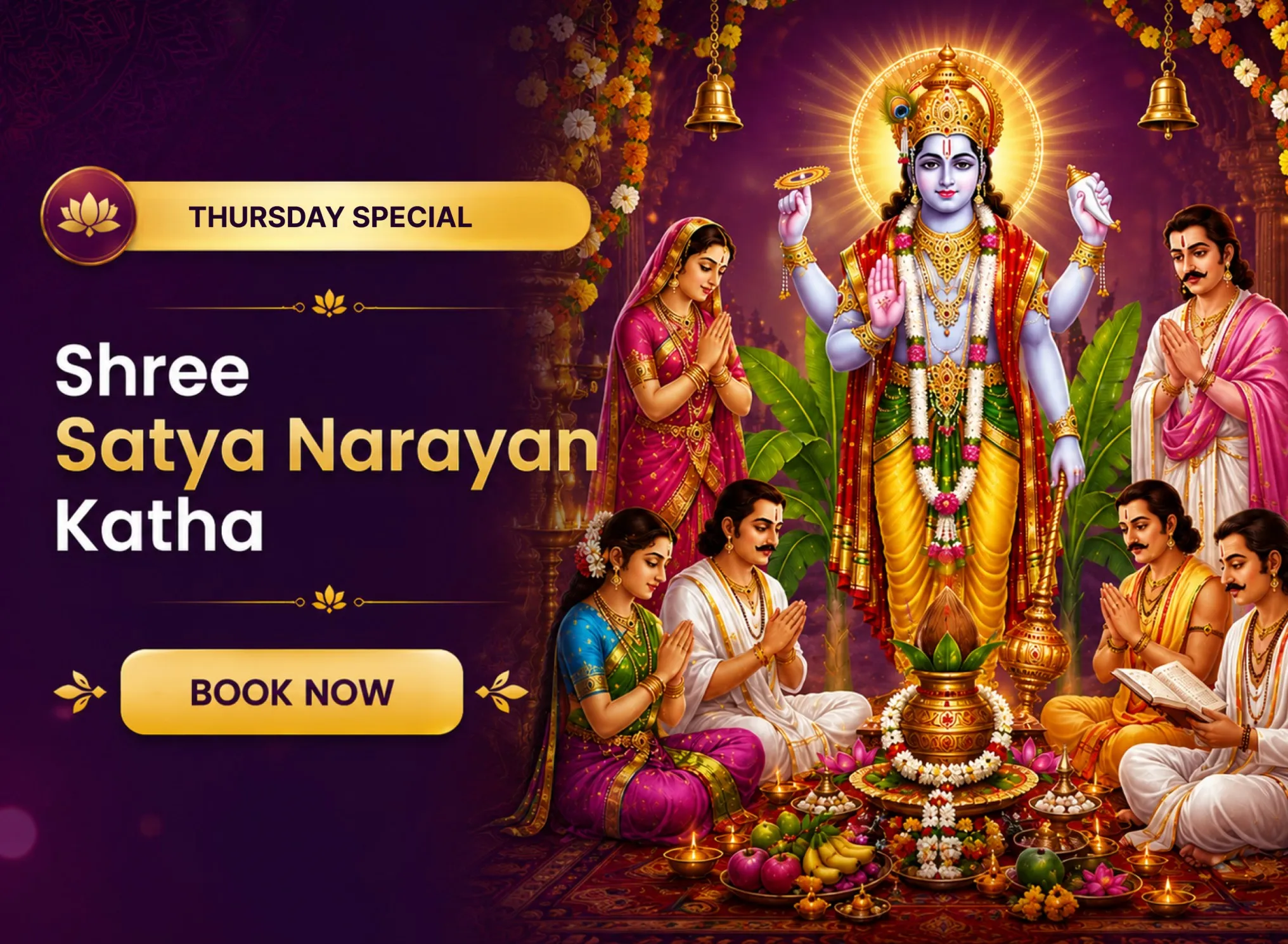
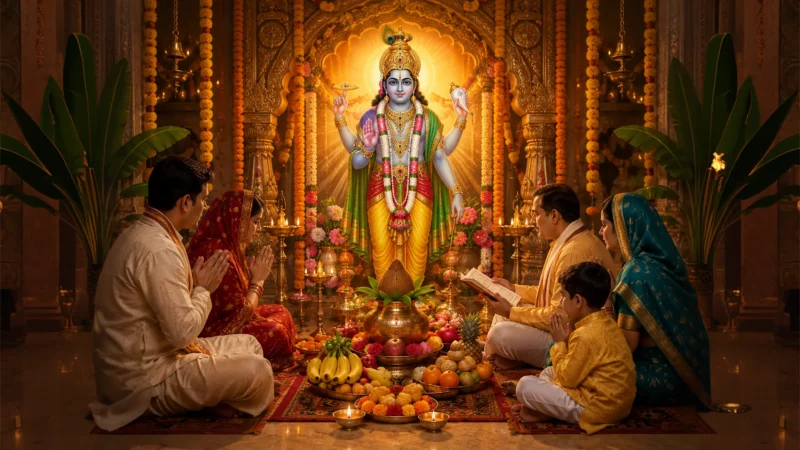
Satyanarayan Katha is a Hindu puja in which devotees gather together, worship Lord Satyanarayan, a form of Lord Vishnu, and listen to a story that teaches the importance of truth, gratitude and keeping one’s word. The katha, or story, is read out loud in five chapters by a pandit while the family and all invited guests sit and listen together.
What Does Satyanarayan Mean?
The name Satyanarayan is made of two Sanskrit words: Satya means truth, and Narayan is one of the names of Lord Vishnu, the preserver of the universe. Together, Satyanarayan means the form of the Lord who is truth in its purest sense.
Lord Satyanarayan is worshipped as a form of Vishnu who blesses his devotees with peace, prosperity and protection in exchange for honesty, humility and devotion.
Where Does Satyanarayan Katha Come From?
Satyanarayan Ki Katha finds its roots in the Skanda Purana, one of the largest and oldest texts in Hindu scripture. Inside the Reva Khanda section of this Purana, the sage Suta narrates the story to a gathering of rishis in the forest of Naimisharanya.
Also Read: The Powers Of Baglamiukhi Mata & How To Perform Puja At Home
Best Time to Perform Satyanarayan Vrat Katha
One of the most appealing things about this puja is its flexibility. Shri Satyanarayan Vrat Katha does not need a fixed festival date. It can be performed almost any day of the year, which is one reason it fits so easily into modern, busy lives.
That said, certain days are considered especially auspicious for this puja.
- Purnima, the full moon day, every month: This is the most common and most preferred day for Satyanarayan Katha.
- Sankranti, marking the change of season, is another popular choice.
- Specific months such as Kartik, Vaishakh, Chaitra, and Shravan are considered particularly fruitful for this vrat, with Kartik Purnima being one of the most celebrated dates.
- Important life events, including a housewarming or griha pravesh, a wedding, the birth of a child, the start of a new job or business, recovery from illness, or any major personal achievement, are common reasons families choose to perform this katha as an offering of thanks.
- Out of pure devotion, with no specific reason at all. Many families simply make it a monthly or yearly tradition.
The one day that is generally avoided for this puja is Amavasya, the new moon night. While the puja can technically be done at any time of day, the evening hours are considered slightly more favourable, though a morning puja is just as acceptable if that works better for the family.
Also Read: Why You Should Perform Kaal Sarp Dosh Puja?
When Should You Perform Shri Satyanarayan Vrat Katha?
- At the time of a wedding: Performing Satyanarayan Katha during the wedding or just after the wedding ceremony is a way to seek blessings, peace, and a smooth life ahead for the new couple.
- During Griha Pravesh or housewarming: Satyanarayan Vrat Katha is performed to fill the new home with positive energy, good health and long-lasting happiness from the very first day.
- After the birth of a child. When a new child is born into the family, many parents and grandparents perform this katha to thank God for the blessing and to pray for the child’s health and a bright future.
- Before or after starting a new business: Entrepreneurs and traders have long turned to Shree Satyanarayan Katha when starting something new, whether it is a small shop, a big company or a new career.
- After a wish has been fulfilled: Many people make a silent promise to Lord Satyanarayan that if a particular wish comes true, they will perform the vrat as an offering of thanks. Once that wish is fulfilled, the puja becomes a way to keep their word and express genuine gratitude.
- On festival days: Sankranti and other auspicious calendar days are also chosen by many families to perform Satyanarayan Katha, especially when they want to combine the festival’s energy with the blessings of the vrat.
- During difficult phases of life: When life feels uncertain, when worries seem to pile up, or when nothing appears to be going right, many families turn to Satyanarayan Bhagwan Ki Katha as a source of strength, peace and hope.
Changes You Will Notice After Performing Satyanarayan Katha
Families across India and abroad continue to perform this vrat for reasons that go far beyond ritual. Here is a deeper look at the benefits most often associated with Satyanarayan Bhagwan Ki Katha.
Benefits of the Satyanarayan Vrat Katha
- Brings peace and harmony into the home. The atmosphere created by the puja is believed to settle the mind and ease tension within the family. Many people say the home feels noticeably calmer for days after the puja.
- Helps remove obstacles and worries. Just as Ganesh Puja at the start of the ritual clears the path for the main worship, the overall vrat is believed to clear away the small and large obstacles that hold a family back, whether in health, finances or relationships.
- Supports a smooth start to new beginnings. Housewarmings, weddings, new jobs, and new businesses are among the most common occasions for this katha. Families perform it hoping for a steady and successful path ahead in whatever chapter of life they are entering.
- Helps in the fulfilment of sincere wishes. The vrat is closely connected to the idea of manokamna purti, meaning the fulfilment of heartfelt desires.
- Builds a sense of gratitude. Not every family performs this puja during a difficult time. Many do it simply to say thank you for the good things already present in their lives, which keeps the practice rooted in gratitude rather than only asking for more.
- Believed to ease the weight of past mistakes. The story of Sadhu and King Tungadhwaja both show that sincere devotion, even after a mistake, can set things right again. This gives many devotees comfort and hope, regardless of what they may be going through.
These benefits, taken together, explain why Satyanarayan Vrat Katha remains one of the most widely performed pujas even in modern, fast-paced life.
The Story Behind Satyanarayan Katha
The Satyanarayan Katha tells a beautiful story that takes us on a faith journey. Doing the puja and reciting the Satyanarayan Katha can bring us harmony as well as prosperity. The Satyanarayan Katha is a famous Hindu ritual. People perform the Satyanarayan katha on special occasions, such as birthdays, anniversaries, as well as housewarmings.
Satyanarayan Katha
The Satyanarayan Katha is the most essential part of the Satyanarayan Pooja procedure. It teaches us many lessons of faith as well as devotion. During the Satyanarayan Katha, family, as well as friends, gather together to read and listen to the story. Reading the Satyanarayan Katha at home before any auspicious occasion like marriage can give the blessings of the god to the family. It is split into five parts or Adhyayas.
Part One
This part of the story tells about Narad Muni’s trip to Earth. He was visiting all three Lokas. When Narad Muni reached Earth, he saw great misery. People were suffering, and there was sadness all around. Therefore, Narad Muni went to the devlok and asked lord Satyanarayan for a solution. Upon which, the god told him the importance of Satyanarayan Puja and vrat.
Part Two
The second part of the story tells the tale of a Brahmin. The Brahmin begged for food and for survival. This made Lord Satyanarayan pity the Brahmin. Therefore, he visited the Brahmin as another Brahmin.
Then, he told the importance of Satyanarana Vratham and how to perform the puja. This made the Brahmin gain the blessings of lord Satyanarayan. Furthermore, a woodcutter also benefited by observing and performing the pooja himself.
Part Three
The third part of the Satya Narayan ki katha talks about a merchant. Once, he saw a king perform the Satyanarayan puja and asked about it. Therefore, the king told him the importance of the puja. The merchant took a vow to perform the puja after the birth of his son. But he forgot to do so.
This angers lord Satyanarayan, and hence, the merchant faces various difficulties. His wife performs the pooja and completes his vow. Therefore, he is now free from all the obstacles.
Part Four
The fourth adhyaya of the Satyanarayan katha talks about the importance of Prasad. In this part, a daughter forgets to eat prasad after conducting the pooja. She does so because her father and husband arrive while she is doing the pooja.
This makes her face severe problems. Afterwards, the daughter eats the prasad and sincerely completes the pooja to receive Satyanarayan Katha benefits.
Part Five
Part five is the final part of the Satyanarayan Katha. In this part, we learn about the various teachings of the stories we have read so far. It also tells us about a King who saw a group of people performing the puja.
Therefore, he did not accept Prasad from them and threw the Prasad away. God got furious at the king’s ego and taught him a lesson. Upon this, the king realised what he did was wrong and worshipped the god with devotion.
How Many Adhyay in Satyanarayan Katha?
This is one of the most commonly searched questions before the puja, so here is a straight answer. Satyanarayan Katha has five adhyayas, or chapters. Each one is short and is read out loud by the pandit during the puja, with the family and all guests listening together.
Here is a quick look at what each Satyanarayan Katha Adhyay covers:
- Adhyay 1 – Narada’s question to Lord Vishnu and the Lord’s explanation of the vrat.
- Adhyay 2 – The story of the poor Brahmin and the woodcutter, both transformed by the vrat.
- Adhyay 3 – King Ulkamukha and the merchant Sadhu, whose daughter Kalavati is born.
- Adhyay 4 – Sadhu’s forgotten promise, the hardships that follow, and the family’s redemption.
- Adhyay 5 – King Tungadhwaja’s pride, loss and eventual humility.
Some versions of the katha include a short closing blessing after the fifth chapter, but these five adhyayas form the complete heart of every Satyanarayan Puja performed in homes and temples across the country.
Vrat Rules to Keep in Mind
Satyanarayan Katha is one of the more forgiving and accessible rituals in Hindu practice, but a few simple rules are worth following.
- Many devotees choose to keep a light fast on the day of the puja, though this is not compulsory. Sincere devotion matters more than strict fasting.
- The prasad must never be refused or treated carelessly. The story of King Tungadhwaja is a direct reminder of this.
- Try to listen to all five adhyayas of the katha without leaving midway once the reading has begun.
- Keep the puja space and your own clothing clean and neat throughout the ceremony.
- If you have made a promise to Lord Satyanarayan after a wish came true, do not delay in performing the puja. Sadhu’s story clearly shows what happens when a promise is kept waiting.
Satyanarayan Katha Aarti
The puja always ends with this well-loved aarti, sung together by everyone present with a lit lamp.
Jai Lakshmi Ramana, Swami Jai Lakshmi Ramana Satyanarayan Swami, Jan Patak Harana Jai Lakshmi Ramana…
Ratna Jadit Sinhasan, Adbhut Chhabi Raje Narad Karat Niranjan, Ghanta Dhwani Baje Jai Lakshmi Ramana…
Prakat Bhaye Kali Karan, Dwij Ko Daras Diyo Budho Brahman Bankar, Kanchan Mahal Kiyo Jai Lakshmi Ramana…
Durbal Bhil Kathiaro, Jin Par Kripa Kari Chandrachood Ek Raja, Tinki Vipati Hari Jai Lakshmi Ramana…
Vaishya Manorath Payo, Shraddha Taj Dinhi So Phal Bhogyo Prabhuji, Phir Astuti Kinhi Jai Lakshmi Ramana…
Bhav Bhakti Ke Karan, Chhin Chhin Roop Dharyo Shraddha Dharan Kini, Tinka Kaaj Saryo Jai Lakshmi Ramana…
Gwal Bal Sang Raja, Ban Mein Bhakti Kari Man Vanchit Phal Dinho, Deen Dayalu Hari Jai Lakshmi Ramana…
Chadhat Prasad Sawayo, Kadali Phal Mewa Dhoop Deep Tulsi Se, Raje Sat Deva Jai Lakshmi Ramana…
Shri Satyanarayan Ji Ki Aarti, Jo Koi Nar Gaave Riddhi Siddhi Sukh Sampatti, Sahaj Roop Paave Jai Lakshmi Ramana, Swami Jai Lakshmi Ramana Satyanarayan Swami, Jan Patak Harana
Why Choose InstaAstro for Satyanarayan Katha?
InstaAstro brings together devotion and convenience in one place. Here is why thousands of families choose InstaAstro when they want to perform Satyanarayan Vrat Katha at home.
- Verified and experienced pandits: Every pandit on InstaAstro is checked for knowledge and experience. You get a priest who knows all five adhyayas of the Satyanarayan Katha and can perform the full puja vidhi correctly.
- Booking that takes minutes. The entire booking process happens online in just a few steps. You pick the date, the time and the type of puja, and InstaAstro handles the rest.
- Pujas performed on your chosen date. Whether you want the puja on the coming Purnima, on a housewarming date, before a wedding, or on any other day that holds meaning for your family, InstaAstro schedules the pandit around your chosen date and time.
- Perfect for families inside and outside India: Whether you are in Delhi, Mumbai, Bengaluru or settled abroad, InstaAstro makes it possible for your family to have a proper Satyanarayan Katha performed with full devotion and no stress.
Conclusion
Satyanarayan Katha is not just a ritual. Performing this puja, whether on Purnima, at a wedding, during a housewarming or simply out of thankfulness, is one of the most meaningful things a family can do together.