There is one goddess who is the mother of the Vedas, the light of all wisdom, and the divine force behind every moral thought. Her name is Maa Gayatri, and her pooja is the most powerful gift you can give your life.
Who Is Goddess Gayatri?
Suggested Puja
Sri Sukta Yagya To Get Maa's Blessings
Remove Karmic Blockages and Career Delays
Maa Gayatri, also known as Gayatri Mata, Vedamata, and Gayathri Goddess, is one of the most exalted and revered deities in all of Vedic tradition.
She is not simply a goddess. She is the living, personalised form of the Gayatri Mantra itself, the most sacred hymn in Hinduism, first recorded in the Rig Veda over 3,500 years ago.
Goddess Gayatri is regarded as the mother of all four Vedas – the Rig Veda, Yajur Veda, Sama Veda, and Atharva Veda.
She is the divine energy that animates all things. She is described in the scriptures as “Supreme pure consciousness” – the light that illuminates the intellect and guides the soul toward righteousness.
In the Bhagavad Gita (Chapter 10, verse 35), Lord Krishna himself declares: “Among all poetry, I am the Gayatri verse chanted by the initiated.” – a statement that reveals the extraordinary divine stature of this goddess and her mantra.
Also Read: The Powers Of Performing Maa Baglamukhi Puja
Gayathri Meaning: What Does the Name Signify?
The name Gayatri comes from two Sanskrit roots: Gaya (vital life force/senses) and Tri (protector/one who saves).
Gayathri Meaning literally is: “the one who protects those who sing her praise.”
She is the goddess who protects the five pranas, the five vital life forces, of all those who chant her mantra with sincerity and devotion.
The five vital senses or forces are –
- Prana (Inward/Forward-Moving Air): Focused on the Chest and head regions, it controls inhalation and sensory intake. It absorbs energy from food, air, and thoughts.
- Apana (Downward/Outward-Moving Air): This focuses on the lower abdomen and pelvic floor. It controls elimination and reproduction while governing urination, defecation, menstruation, and childbirth.
- Vyana (Diffusive / Pervading Air): Focused on the entire nervous and circulatory systems, this force controls circulation and movement, distributes nutrients and oxygen, and coordinates muscular motion.
- Udana (Upward-Moving Air): This force targets the throat, neck, and head. It controls growth, speech, and expression, and governs the vocal cords, swallowing, and higher awareness.
- Samana (Equalising / Balancing Air): This is for the Navel and stomach area. It controls digestion and metabolism, stokes the digestive fire (Jatharagni), and incorporates nutrients.
The main Gayatri Mantra itself is composed of 24 syllables of deep meaning, each representing:
- One of the 24 Vedic Rishis
- One of the 24 Vedic metres (Chandas)
- One of the 24 Vedic Devatas
This layered, multi-dimensional sacred structure is why the main Gayatri Mantra is called the “king of all Vedic mantras”. Other Gayatri Mantras are mantras combined with those of other gods and goddesses.
The Gayatri Mantra: The Most Powerful Mantra in the Universe
Though Gayatri Mata Ki Aarti is quite famous in temples, the Maha Gayatri mantra is recited in various important Pujas, especially in the Gayatri Jayanti. Moreover, it is also the 21 Brahmin 1,08,000 Gayatri Mantra Jaap Mahaanushthan.
ॐ भूर्भुवः स्वः तत्सवितुर्वरेण्यं
भर्गो देवस्य धीमहि धियो यो नः प्रचोदयात्॥
Om Bhur Bhuvah Svah Tat Savitur Varenyam
Bhargo Devasya Dhimahi Dhiyo Yo Nah Prachodayat
Complete meaning: “We meditate upon the supreme divine radiance of the Sun – that divine light which destroys all sins and ignorance. May it illuminate our intellect and guide us along the righteous path.”
What Does Goddess Gayatri Look Like?
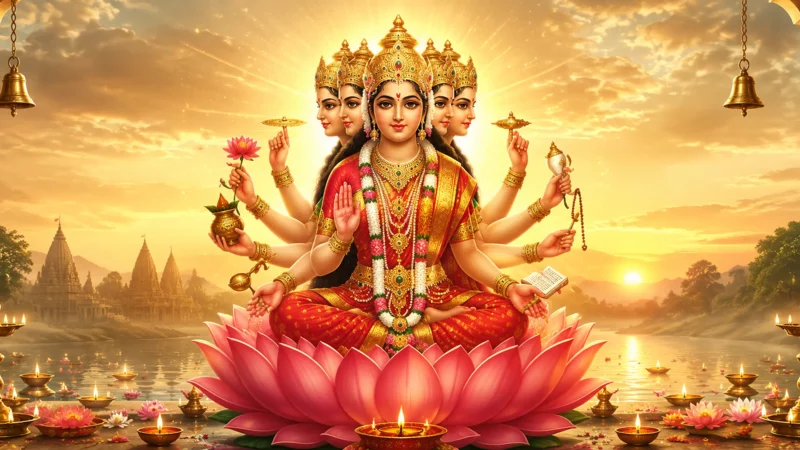
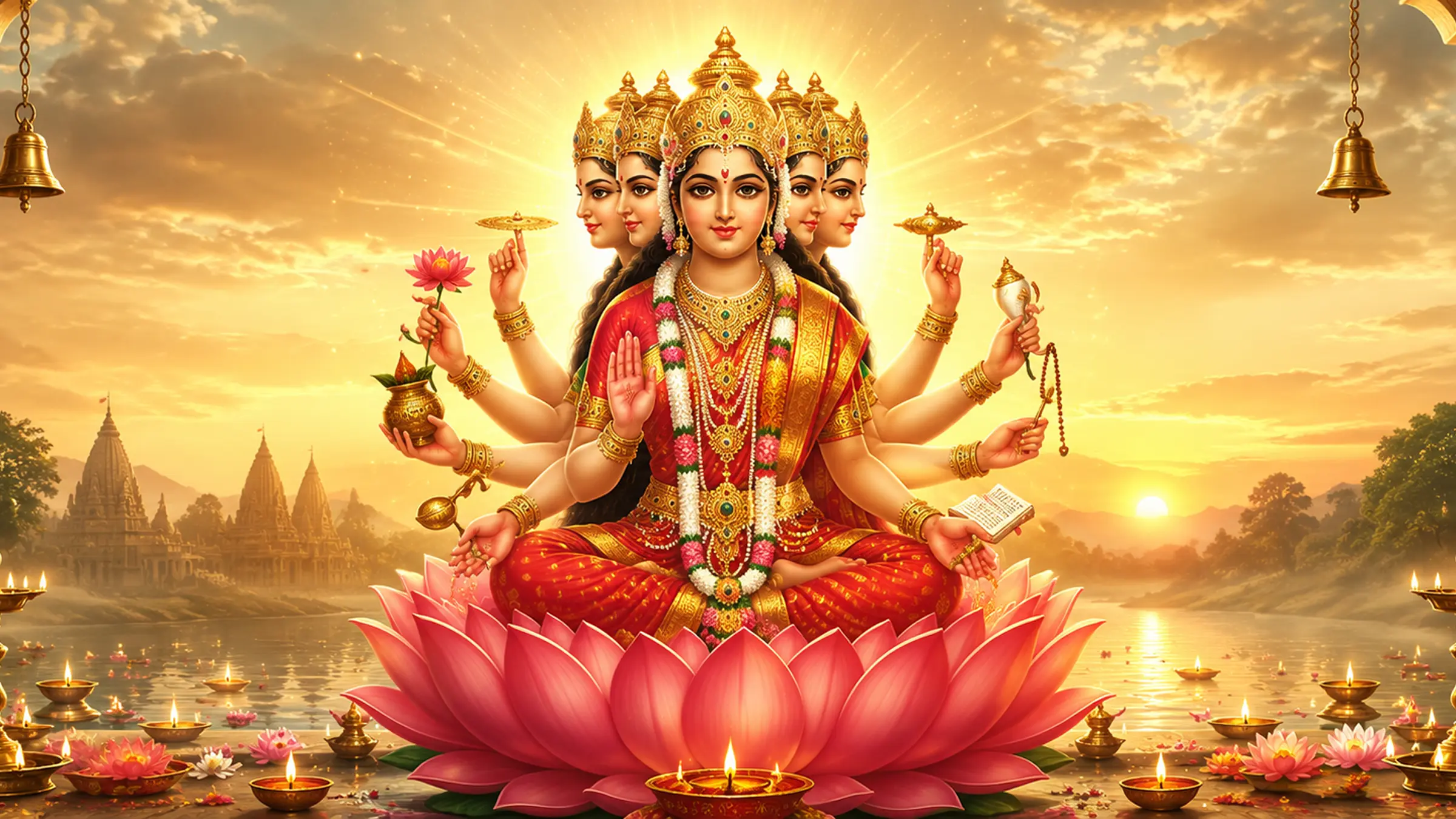
Goddess Gayatri has one of the most magnificent divine forms in all of Hindu iconography.
- Five Heads (Panchamukhi): Each head represents one of the five elements – Earth (Prithvi), Water (Jala), Fire (Teja), Air (Vayu), and Ether (Aakasha). Together, they represent Maa Gayathri’s absolute dominion over the entire universe.
- Ten Eyes: The devi’s ten eyes gaze in all eight directions, as well as at the earth and the sky, symbolising her all-seeing, all-knowing nature.
- Ten Arms: Carrying the weapons and symbols of all three major deities – the Shankha, Chakra, and Gada of Vishnu; the Trishul of Shiva; the Kamandalu, Akshamala, and Pustaka of Brahma; and the Varada and Abhaya mudras.
- Seated on a Red Lotus: It signifies divine wealth, purity, and spiritual luxury.
- White Swan as Mount: The hamsa, symbolising wisdom, discernment, and the ability to separate truth from illusion
- Three Eyes (Tri-Netra): Among all goddesses, Maa Gayatri is unique in having three eyes, like Lord Shiva, reflecting her supreme status.
Also Read: Why You Need Kaal Sarp Dosh Nivaran Puja?
Sacred Items Associated with Maa Gayatri
Worshipping Maa Gayatri with specific items significantly boosts the puja’s effect and pleases Goddess Gayatri.
- Vishudha Chakra activation: Gayatri Pooja is directly linked to the Vishudha (throat) Chakra – the energy centre governing speech, truth, and expression. This is why the mantra boosts speech and communication so powerfully.
- Jupiter (Guru): Since Goddess Gayatri is astrologically associated with Jupiter, one must wear Yellow Sapphire (Peela Pukhraj) during her puja. It helps those with Jupiter-related challenges in their horoscope.
- 4 Mukhi or 5 Mukhi Rudraksha: Wearing either of these Rudrakshas during Gayatri Mantra chanting is said to multiply the mantra’s power manifold. It activates both the intellect and the voice simultaneously.
- Gayatri Yantra: Establishing a Gayatri Yantra at the place of worship continuously echoes with Maa Gayatri’s divine energy, even between active puja sessions.
- Yellow flowers, yellow sweets, and ghee lamp: Yellow is Goddess Gayatri’s sacred colour. It is the colour of Jupiter, wisdom, and divine grace. Offerings in yellow especially please her.
What is the Story of Gayatri Devi?: The Birth
Once, while performing a grand yajna at Pushkar, Lord Brahma waited for his consort, Goddess Savitri, who was late because she was waiting for the other goddesses. Unable to postpone the sacred ritual, the assembled gods, particularly Vishnu, discovered a beautiful divine young woman who embodied the essence of the Gayatri Mantra. With all the gods as witnesses, Brahma married her.
When Goddess Savitri arrived, agitated, she cursed those present. But Maa Gayatri, empowered by the yajna’s sacred energy, softened each curse with blessings. She granted Pushkar the status of king of all pilgrimages and blessed all those involved.
In the story of Gayatri Devi, this is why the sacred city of Pushkar has both the Savitri Temple and Gayatri Mata Temple. Also, this is why devotees call Maa Gayatri – “the protector of divine order”.
Another Famous Legend of Gayatri Devi
Another famous legend in Gayatri Devi mythology tells of her marriage to the great sage Vishwamitra. According to this tradition, Vishwamitra was so powerful that he could create his own universe. Seeking even greater power, he decided one day to perform a sacred yagna but realised he could not complete it alone.
So, Sage Vishwamitra meditated deeply on Maa Gayatri, and she appeared in his vision. Gayatri Devi agreed to assist him on one condition – that he marry her. Vishwamitra accepted this, and they united in a grand ceremony.
From their divine union, Gayatri and Vishwamitra became the spiritual parents of many great sages and seers. These sages composed the Vedas and spread divine knowledge throughout the world.
Also Read: What Are The Effects Of Rahu Dosha In Your Life?
What are the benefits of Worshipping Maa Gayatri?
Maa Gayatri is the goddess of wisdom, light, and divine favour. Her pooja does not simply address one problem; it elevates the entire quality of a person’s life from within.
Here are the top 10 reasons why Gayathri Goddess Puja should be performed.
Academic and Professional Success
Students who chant the Gayatri Mantra consistently report sharper memory, stronger concentration, and measurably greater academic success. Professionals attending Gayatri Pooja experience clearer thinking, improved relationships with authority figures, and significantly faster, more sustained career growth.
Protection of the Family
Maa Gayatri represents Saraswati, Lakshmi, and Parvati – wisdom, wealth, and power – in one supreme divine form. Worshipping her extends blessings across every dimension of family life, including education, financial prosperity, good health, and genuine, lasting harmony among family members.
Destruction of Sins and Negative Karma
The word Bhargo in the Gayatri Mantra means “the divine radiance that destroys sin.” Mata Gayatri’s pooja dissolves deeply accumulated karmic burdens from this life and past lives – clearing the path for fresh, unobstructed progress in every area of life.
Protection of the Five Senses and Life Forces
Maa Gayatri’s five heads represent the five pranas – the vital life forces of the human body. The 21 Brahmin 1,08,000 Gayatri Mantra Jaap Mahaanushthan Puja actively protects these fundamental energies, contributing directly to sustained physical health, deep mental balance, and lasting emotional stability.
Purification of Speech and Thought
Recitation of the Gayatri Mantra purifies the subtle body and the faculty of speech from within. This inner purity then radiates outward – improving communication, dissolving unnecessary conflicts, and naturally attracting trustworthy, supportive people into the devotee’s life.
Also Read: What Changes You Will Feel After Performing Satyanarayan Katha?
Boosts Intellect / Intelligence
The Gayatri Mantra is a direct prayer for divine light to illuminate the mind. Regular Gayatri Pooja sharpens mental clarity, improves decision-making, and removes confusion, helping devotees consistently choose the right path at every critical crossroad in life.
Relief from Planetary Bad Influences
Goddess Gayatri is directly associated with Jupiter (Guru) in Vedic astrology. Her sincere worship is a powerful, time-tested remedy for those with an afflicted Jupiter in their birth chart, restoring wisdom, grace, abundance, and the full restoration of personal fortune over time.
Purification of the Home and Environment
The Gayatri Mantra chanted during a sincerely performed pooja purifies the entire energetic field of the home. Negative influences, unresolved past trauma, and hostile energies accumulated in the living space are systematically cleared, and calm, positive, and uplifting vibrations are introduced.
Mental Peace and Emotional Strength
Devotees who observe regular Gayatri Pooja consistently report a significant reduction in anxiety, unexplained fear, and emotional disturbance. The sacred vibrational frequency of the mantra directly calms the nervous system, stabilises the mind, and restores deep, lasting inner peace.
Spiritual Growth and Liberation
The Gayatri Mantra is considered a sonic incarnation of Brahman – the Supreme Reality itself. Hence, the 21 Brahmin 1,08,000 Gayatri Mantra Jaap Mahaanushthan accelerates spiritual evolution, boosts meditation, and ultimately guides the sincere devotee toward moksha. It signifies final liberation from the cycle of birth and death.
Best Days to Worship Maa Gayatri
- Sunday: Goddess Gayatri is the presiding deity of the Sun (Savitur). Worshipping her on Sunday aligns directly with her solar energy and boosts mantra jaap energy.
- Ekadashi (11th lunar day): Gayatri Jayanti falls on Ekadashi of Shukla Paksha in the month of Jyeshtha, the most sacred annual day for her worship.
- Shravan Purnima: The full moon in Shravan is deeply auspicious for Gayatri Pooja. Many traditions celebrate Gayatri Jayanti on this day as well.
- Navratri: It is the nine sacred nights of the Divine Mother that amplify all goddess worship, including Maa Gayatri’s. It is an ideal time for an extended Gayatri Mantra Jaap.
- Gayatri Japam Day: Observed the day after Shravan Purnima (Shravan Upakarma day), this is the specific day in the Vedic calendar dedicated entirely to Gayatri Mantra recitation.
Best Timings to Worship Maa Gayatri: The Three Sandhyas
Vedic tradition prescribes three specific windows every day called Sandhya Kaal when Maa Gayatri’s energy is most accessible, and the Gayatri Mantra carries maximum power.
Pratah Sandhya – Sunrise (Morning Prayer)
This is the most powerful of the three Sandhyas. Goddess Gayatri is the presiding deity of the morning prayer and the Rig Veda, making sunrise her most sacred hour. The chant of Gayatri Mantra at this time is believed to carry ten times the spiritual merit of chanting at any other point in the day.
So, Face East toward the rising sun. Then, sit in a clean, quiet space, and begin your mantra practice as the first rays of sunlight appear.
Madhyahna Sandhya – Noon (Midday Prayer)
The second Sandhya falls at solar noon, when the sun is at its zenith. This timing aligns with Maa Gayatri’s role as the goddess of Savitru – the full, brilliant solar force. It is ideal for a shorter, focused round of 27 or 54 chants, reinforcing the morning’s intention with midday solar energy.
Sayam Sandhya – Sunset (Evening Prayer)
The third and final Sandhya is at sunset. This is the transition point between day and night – a spiritually sensitive window. Chanting the Gayatri Mantra at sunset cleanses the spiritual impurities accumulated during the day. It also restores inner balance and prepares the mind for a peaceful, undisturbed night.
Famous Gayatri Mata Temple in India
Brahma Mandir, Kashi (Varanasi) – The Most Sacred Site
The Brahma Mandir in Kashi holds an unparalleled place in Maa Gayatri worship. Kashi – the eternal city of Lord Shiva – is the most spiritually powerful location on Earth. This is precisely why InstaAstro offers the online 21 Brahmin 1,08,000 Gayatri Mantra Jaap Mahaanushthan performed here.
Gayatri Mata Temple, Pushkar (Rajasthan)
Located on the Nilgiri Hill at the eastern edge of the sacred Pushkar Lake, this ancient Gayatri Mata Temple is also called Paap Mochani Mandir – the destroyer of sins. People say Maa Gayatri herself declared the Pushkar location as the king of all pilgrimages.
Shantikunj, Haridwar (Uttarakhand)
Founded by the revered saint Pandit Shriram Sharma Acharya, Shantikunj is the global headquarters of the All World Gayatri Pariwar. It is the world’s largest institution dedicated to Gayatri Mata worship. Millions of pilgrims visit every year.
Gayatri Shakti Peeth, Mathura (Uttar Pradesh)
Situated in Mathura, the holy birthplace of Lord Krishna, this Gayatri Shakti Peeth is among the most visited temples dedicated to Gayathri Goddess in North India. The Goddess Gayatri Puja at this sacred site fulfils sincere prayers quickly, especially for wisdom, children, and overcoming deep-rooted karmic obstacles.
Gayatri Mandir, Chitrakoot (Madhya Pradesh)
Set within the deeply sanctified forests of Chitrakoot, this ancient Gayatri Mandir is where Lord Rama lived during his years of exile. Pujas performed here are believed to dissolve ancestral karma and grant freedom from repeating life patterns.
What Is 21 Brahmin 1,08,000 Gayatri Mantra Jaap Mahaanushthan?
This is not an ordinary puja. This is a Mahaanushthan – a great undertaking of sacred proportions for a complete spiritual transformation and the greatest Maa Gayatri blessings.
The 21 Brahmin 1,08,000 Gayatri Mantra Jaap Mahaanushthan, offered by InstaAstro Puja and performed at the sacred Brahma Mandir in Kashi, is one of the most powerful Gayatri Pooja rituals available today.
Here is what makes it extraordinary:
- 21 qualified Brahmin priests perform the ritual simultaneously
- Together, they complete a total chant of 1,08,000 Gayatri Mantras – the most sacred count in Vedic tradition
- The puja is performed at the Brahma Mandir in Kashi – one of the most spiritually powerful sites on Earth
- It includes a full Sankalp in the devotee’s name and gotra, connecting the puja’s energy directly to the individual and their family
- The ritual is conducted on a personally determined auspicious muhurat based on the devotee’s horoscope
- A sacred Havan (fire ritual) is performed at the completion of the mantra jaap
- Prasad is distributed to Brahmins in the devotee’s name as an act of spiritual merit
Why 1,08,000 Chants of Gayatri Mantra?
In Vedic tradition, 108 is the most sacred number, representing the 108 Upanishads, the 108 names of each deity, and the precise mathematical relationship between the Sun, Moon, and Earth.
Multiplied by 1,000, the 1,08,000 chant count represents a complete and total invocation of Maa Gayatri’s divine grace, leaving no aspect of the devotee’s life untouched by her light.
Who Should Book This Mahaanushthan?
- Those seeking deep karmic cleansing and liberation from past mistakes
- Individuals facing persistent obstacles in career, education, or relationships
- Those wishing to activate intelligence, clarity, and wisdom in their lives
- Families wanting holistic protection and divine blessings for all members
- Anyone undertaking a new business, marriage, or major life chapter
- Those who want to offer the most complete and powerful form of Gayatri Pooja on behalf of a loved one
Conclusion: Let Maa Gayatri’s Light Guide Your Life
Maa Gayatri is not just a goddess to be prayed to. She is the divine light that lives inside every conscious being, waiting to be awakened through sincere worship, mantra, and devotion. Her pooja is an invitation to clarity over confusion, to wisdom over ignorance, to light over darkness. Jai Gayatri Maa!