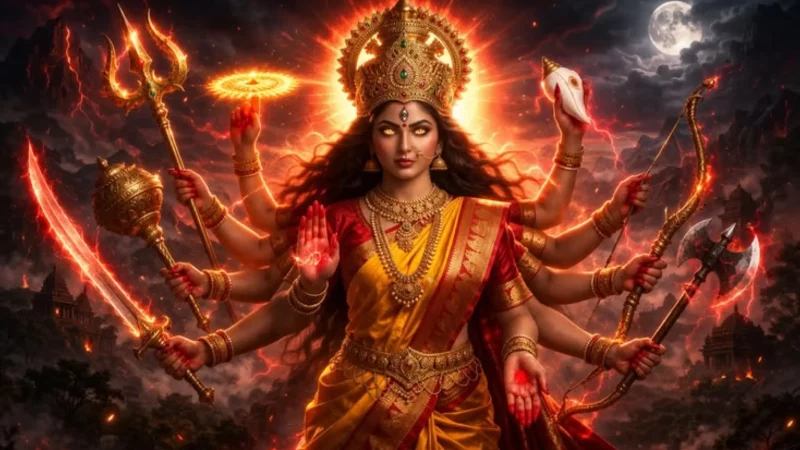
Maa Durga Kavach is one of the most chanted hymns in the whole of India. People chant it before exams, before a hard day at work, before travel, and every single day of Navratri. It is called a “kavach” because that word means armour. When you chant it, you are asking Maa Durga to cover your body and mind the way a shield covers a soldier.
What is Durga Kavach?
Suggested Puja

Sheeghra Santan Prapti Mahapuja
Seeking Santaan Prapti & blessing of children
Durga Kavach, also written as Durga Kawach, is a hymn from the Markandeya Purana. It forms part of the Durga Saptashati, also called Devi Mahatmyam, which is the main text on Goddess Durga read during Navratri.
The Kavach is built in a simple way. Each verse calls on one form of the Goddess to guard one part of the body. One verse guards the head, the next guards the eyes, another guards the chest, and so on until the whole body is covered from head to toe.
How Durga Kavach Helps in Santaan Prapti?
Durga Kavach is a sacred prayer dedicated to Goddess Durga, who is worshipped as the protector and nurturer of life. In astrology and spiritual traditions, it is often recommended for couples seeking Santaan Prapti, or the blessing of children, especially when they face repeated challenges.
This is why many people chant the Durga Kavach with a wish for their children. The Kavach itself speaks about this in one of its verses, where the Goddess is asked to protect one’s sons and guard the family line. Because of this, many couples who are hoping for a child add Durga Kavach to their daily prayers, along with faith and patience.
Also Read: The Powers Of Doing Maa Baglamukhi Puja
The Nine Forms of Durga in the Kavach
The Kavach namaes all nine forms of the Goddess, worshipped one by one during the nine nights of Navratri.
- Shailaputri, daughter of the mountain
- Brahmacharini, the one who practices deep penance
- Chandraghanta, the one who wears the moon like a bell
- Kushmanda, the creator of the universe
- Skandamata, mother of Skanda
- Katyayani, born in the house of sage Katyayana
- Kalaratri, the dark night that ends fear
- Mahagauri, the pure and radiant one
- Siddhidatri, the giver of every kind of success
Each one carries her own energy and her own gift. During Navratri, devotees worship one form each day so that by the ninth night, they have called on the full strength of the Goddess.
Also Read: Why Kaal Sarp Dosh Nivaran Puja Is Important For You
Durga Kavach Lyrics in Sanskrit
ॐ नमश्चण्डिकायै॥
मार्कण्डेय उवाच
यद्गुह्यं परमं लोके सर्वरक्षाकरं नृणाम् ।
यन्न कस्यचिदाख्यातं तन्मे ब्रूहि पितामह ॥ १ ॥
ब्रह्मोवाच
अस्ति गुह्यतमं विप्र सर्वभूतोपकारकम् ।
देव्यास्तु कवचं पुण्यं तच्छृणुश्व महामुने ॥ २ ॥
प्रथमं शैलपुत्रीति द्वितीयं ब्रह्मचारिणी ।
तृतीयं चन्द्रघण्टेति कूष्माण्डेति चतुर्थकम् ॥ ३ ॥
पञ्चमं स्कन्दमातेति षष्ठं कात्यायनीति च ।
सप्तमं कालरात्रिश्च महागौरीति चाष्टमम् ॥ ४ ॥
नवमं सिद्धिदात्री च नवदुर्गाः प्रकीर्तिताः ।
उक्तान्येतानि नामानि ब्रह्मणैव महात्मना ॥ ५ ॥
अग्निना दह्यमानस्तु शत्रुमध्ये गतो रणे ।
विषमे दुर्गमे चैव भयार्ताः शरणं गताः ॥ ६ ॥
न तेषां जायते किञ्चित् अशुभं रणसङ्कटे ।
नापदं तस्य पश्यामि शोकदुःखभयं न हि ॥ ७ ॥
यैस्तु भक्त्या स्मृता नूनं तेषां सिद्धि: प्रजायते ।
प्रेतसंस्था तु चामुण्डा वाराही महिषासना ॥ ८ ॥
ऐन्द्री गजसमारुढ़ा वैष्णवी गरुडासना ।
माहेश्वरी वृषारुढ़ा कौमारी शिखिवाहना ॥ ९ ॥
ब्राह्मी हंससमारुढ़ा सर्वाभरणभूषिता ।
नानाभरणशोभाढ्या नानारत्नोपशोभिताः ॥ १०॥
दृश्यन्ते रथमारुढ़ा देव्यः क्रोधसमाकुलाः ।
शङ्खं चक्रं गदां शक्तिं हलं च मुसलायुधम् ॥ ११ ॥
खेटकं तोमरं चैव परशुं पाशमेव च ।
कुन्तायुधं त्रिशूलं च शार्ङ्गमायुधमुत्तमम् ॥ १२॥
दैत्यानां देहनाशाय भक्तानामभयाय च ।
धारयन्त्यायुधानीत्थं देवानां च हिताय वै ॥ १३ ॥
महाबले महोत्साहे महाभयविनाशिनि ।
त्राहि मां देवि दुष्प्रेक्ष्ये शत्रूणां भयवर्धिनि ॥ १४ ॥
प्राच्यां रक्षतु मामैन्द्री आग्नेय्यामग्निदेवता ।
दक्षिणेऽवतु वाराही नैर्ऋत्यां खड्गधारिणी ॥ १५ ॥
प्रतीच्यां वारुणी रक्षेत् वायव्यां मृगवाहिनी ।
उदीच्यां रक्ष कौबेरी ईशान्यां शूलधारिणी ॥ १६ ॥
ऊर्ध्वं ब्रह्माणि मे रक्षेत् अधस्ताद् वैष्णवी तथा ।
एवं दश दिशो रक्षेत् चामुण्डा शववाहना ॥ १७ ॥
जया मे चाग्रतः स्तातु विजया स्तातु पृष्ठतः ।
अजिता वामपार्श्वे तु दक्षिणे चापराजिता ॥ १८ ॥
शिखां मेऽद्योतिनी रक्षेत् उमा मूर्ध्नि व्यवस्थिता ।
मालाधरी ललाटे च भ्रुवौ रक्षेद्-यशस्विनी ॥ १९ ॥
त्रिनेत्रा च भ्रुवोर्मध्ये यमघण्टा च नासिके ।
शङ्खिनी चक्षुषोर्मध्ये श्रोत्रयोर्द्वारवासिनी ॥ २० ॥
कपोलौ कालिका रक्षेत्कर्णमूले तु शांकरी ।
नासिकायां सुगन्धा च उत्तरोष्ठे च चर्चिका ॥ २१ ॥
अधरे चामृतकला जिह्वायां च सरस्वती ।
दन्तान् रक्षतु कौमारी कण्ठ मध्येतु चण्डिका ॥ २२ ॥
घण्टिकां चित्रघण्टा च महामाया च तालुके ।
कामाक्षी चिबुकं रक्षेत् वाचं मे सर्वमङ्गला ॥ २३ ॥
ग्रीवायां भद्रकाली च पृष्ठवंशे धनुर्धरी ।
नीलग्रीवा बहिःकण्ठे नलिकां नलकूबरी ॥ २४ ॥
खड्ग्धारिन्यु भौ स्कन्धो बाहू मे वज्रधारिणी ।
हस्तयोर्दण्डिनी रक्षेत् अम्बिका चाङ्गुलीस्त्था ॥ २५ ॥
नखाञ्छूलेश्वरी रक्षेत्कुक्षौ रक्षेन्नलेश्वरी ।
स्तनौ रक्षेन्महालक्ष्मी: मनः शोकविनाशिनी ॥ २६ ॥
हृदय्म् ललिता देवी उदरम् शूलधारिणी ।
नाभौ च कामिनी रक्षेत् गुह्यं गुह्येश्वरी तथा ॥ २७ ॥
कट्यां भगवती रक्षेज्जानुनी विन्ध्यवासिनी ।
भूतनाथा च मेद्रं मे ऊरू महिषवाहिनी ॥ २८ ॥
जङ्घे महाबला प्रोक्ता सर्वकाम प्रदायिनी ।
गुल्फयोर्नारसिंही च पादौ चामित-तैजसी ॥ २९ ॥
पादाङ्गुली: श्रीर्मे रक्षेत्पादाधस्तलवासिनी ।
नखान् दंष्ट्राकराली च केशांश्चैवोर्ध्वकेशिनी ॥ ३० ॥
रोमकूपेषु कौबेरी त्वचं वागीश्वरी तथा ।
रक्तमज्जावसामांसानि अस्थिमेदांसि पार्वती ॥ ३१ ॥
अन्त्राणि कालरात्रिश्च पित्तं च मुकुटेश्वरी ।
पद्मावती पद्मकोशे कफे चूड़ामणिस्तथा ॥ ३२ ॥
ज्वालामुखी नखज्वाला अभेद्या सर्वसंधिषु ।
शुक्रं ब्रह्माणि मे रक्षेत् छाया छत्रेश्वरी तथा ॥ ३३ ॥
अहंकारं मनो बुद्धिं रक्षमे धर्मचारिणी ।
प्राणापानौ तथा व्यानं समानोदानमेव च ॥ ३४॥
यशः कीर्तिंञ्च लक्ष्मीञ्च सदा रक्षतु वैष्णवी ।
गोत्रमिन्द्राणि मे रक्षेत् पशून्मे रक्ष चण्डिके ॥ ३५॥
पुत्रान् रक्षेन्महालक्ष्मी: र्भार्यां रक्षतु भैरवी
मार्गं क्षेमकरी रक्षेत् वजया सवृतः स्थिता ॥ ३६॥
रक्षाहीनं तु यत्स्थानं वर्जितं कवचेन तु ।
तत्सर्वं रक्ष मे देवि जयन्ती पापनाशिनी ॥ ३७॥
पदमेकं न गच्छेत्तु यदीच्छेच्छुभमात्मनः ।
कवचेनावृतो नित्यं यत्र यत्राधिगच्छति ॥ ३८॥
तत्र तत्रार्थलाभश्च विजयः सार्वकामिकः ।
यं यं कामयते कामं तं तं प्राप्नोति निश्चितम् ॥ ३९॥
परमैश्वर्यमतुलं प्राप्स्यते भूतले पुमान् ।
निर्भयो जायते मर्त्यः संग्रामेष्वपराजितः ॥ ४० ॥
त्रैलोक्ये तु भवेत्पूज्यः कवचेनावृतः पुमान् ।
इदं तु देव्याः कवचं देवानामपि दुर्लभम् ॥ ४१ ॥
यः पठेत्प्रयतो नित्यं त्रिसन्ध्यं श्रद्धयान्वितः ।
दैवी कला भवेत्तस्य त्रैलोक्येपपराजितः ॥ ४२ ॥
जीवेद् वर्षशतं साग्रमपमृत्युविवर्जितः ।
नश्यन्ति व्याधयः सर्वे लूताविस्फोटकादयः ॥ ४३ ॥
स्थावरं जङ्गमं वापि कृत्रिमं चापि यद्विषम् ।
आभिचाराणि सर्वाणि मन्त्रयन्त्राणि भूतले ॥ ४४ ॥
भूचराः खेचराश्चैव जलजाश्चोपदेशिकाः ।
सहजाः कुलजा मालाः शाकिनी डाकिनी तथा ॥ ४५ ॥
अन्तरिक्षचरा घोरा डाकिन्यश्च महाबलाः ।
ग्रहभूतपिशाचाश्च यक्षगन्धर्वराक्षसाः ॥ ४६ ॥
ब्रह्मराक्षसवेतालाः कूष्माण्डा भैरवादयः ।
नश्यन्ति दर्शनात्तस्य कवचे हृदि संस्थिते ॥ ४७ ॥
मानोन्नतिर्भवेद्-राज्ञ: तेजोवृद्धिकरं परम् ।
यशसा वर्धते सोऽपि कीर्तिमण्डितभूतले ॥ ४८ ॥
जपेत्सप्तशतीं चण्डीं कृत्वा तु कवचं पुरा ।
यावद्भूमण्डलं धत्ते सशैलवनकाननम् ॥ ४९ ॥
तावत्तिष्ठति मेदिन्यां संततिः पुत्रपौत्रिकी ।
देहान्ते परमं स्थानं यत्सुरैरपि दुर्लभम् ॥ ५० ॥
प्राप्नोति पुरुषो नित्यं महामाया प्रसादतः ।
Full Durga Kavach Lyrics in English With Meaning
Below is the Shree Durga Kavach with the simple English transliteration and the meaning in plain English. The full hymn has around 47 main verses followed by a closing section on its benefits.
Opening prayer (Viniyoga)
This line is chanted first as a mark of respect before the Kavach begins.
Om Namashchandikayai
Meaning: We bow to Goddess Chandika.
Markandeya asks his question
Yad guhyam paramam loke sarvarakshakaram nrinam, yanna kasyachidakhyatam tanme bruhi pitamaha (1)
Meaning: Markandeya said, O grandfather Brahma, please tell me the secret that protects every person in this world, the one thing that has not been told to anyone else so far.
Brahma begins his answer
Brahmovacha: Asti guhyatamam vipra sarvabhutopakarakam, devyastu kavacham punyam tachchhrinushva mahamune (2)
Meaning: Brahma said, O wise one, there is indeed such a secret that helps all beings. It is the sacred armor of the Devi. Listen to it carefully, great sage.
Prathamam Shailaputri cha dvitiyam Brahmacharini, tritiyam Chandraghanteti Kushmandeti chaturthakam (3)
Meaning: The first form is Shailaputri, the second is Brahmacharini, the third is Chandraghanta, and the fourth is Kushmanda.
Panchamam Skandamateti shashtham Katyayaniti cha, saptamam Kalaratriti Mahagauriti chashtamam (4)
Meaning: The fifth is Skandamata, the sixth is Katyayani, the seventh is Kalaratri, and the eighth is Mahagauri.
Navamam Siddhidatri cha navadurgah prakirtitah, uktanyetani namani brahmanaiva mahatmana (5)
Meaning: The ninth is Siddhidatri. Together, these nine are called the Navadurga, the nine forms of Durga, and their names were spoken by the great Brahma himself.
The promise of protection
Agnina dahyamanastu shatrumadhye gato rane, vishame durgame chaiva bhayartah sharanam gatah (6)
Meaning: Even one caught in fire, or surrounded by enemies on a battlefield, or lost in a dangerous and difficult place, if they take refuge in the Devi out of fear, they will be protected.
Na teshaam jaayate kinchidashubham ranasankate, naapadam tasya pashyaami shokaduhkhabhayam na hi (7)
Meaning: No harm will come to such a person, not even in the worst danger. I see no misfortune, no grief, no pain, and no fear coming near them.
Yaistu bhaktya smrita nunam teshaam vriddhih prajayate, ye tvaam smaranti deveshi rakshase taannasanshayah (8)
Meaning: Those who remember the Devi with devotion will surely grow and prosper. O queen of the gods, there is no doubt that you protect all who remember you.
The Goddesses take their positions
Pretasanstha tu Chamunda Varahi mahishasana, Aindri gajasamarudha Vaishnavi garudasana (9)
Meaning: Chamunda sits on a corpse, Varahi sits on a buffalo, Aindri rides an elephant, and Vaishnavi rides on Garuda, the eagle.
Maheshvari vrisharudha Kaumari shikhivahana, Lakshmih padmasana devi padmahasta haripriya (10)
Meaning: Maheshvari rides a bull, Kaumari rides a peacock, and Goddess Lakshmi, beloved of Vishnu, sits on a lotus with a lotus in her hand.
Shvetarupadhara devi Ishvari vrishavahana, Brahmi hansasamarudha sarvabharanabhushita (11)
Meaning: Ishvari appears in pure white and rides a bull, while Brahmi rides a swan and wears every kind of ornament.
Ityeta mataraha sarvaha sarvayogasamanvitaha, nanabharanashobhadhya nanaratnopashobhitaha (12)
Meaning: All these divine mothers are complete in every spiritual power. They are richly dressed in ornaments and jewels of every kind.
Drishyante rathamarudha devyah krodhasamakulaha, shankham chakram gadaam shaktim halam cha musalayudham (13)
Meaning: These Goddesses can be seen mounted on chariots, fierce with anger, holding a conch, a discus, a mace, a spear, a plough, and a club.
Khetakam tomaram chaiva parashum pashameva cha, kuntayudham trishulam cha sharngamayudhamuttamam (14)
Meaning: They also carry a shield, a lance, an axe, a noose, a long spear, a trident, and the great bow named Sharnga.
Daityanam dehanashaya bhaktanamabhayaya cha, dharayantyayudhaniittham devanam cha hitaya vai (15)
Meaning: They carry these weapons to destroy the demons, to remove fear from their devotees, and to protect the well-being of the gods.
Calling the Goddess by her many names
Namo devyai mahadevyai shivayai satatam namah, namah prakrityai bhadrayai niyataha pranataha sma taam (16)
Meaning: We bow again and again to the great Devi, to the auspicious one. We bow to her as nature itself, the source of all good, and we always offer our respect to her.
Raksham me dehi deveshi jayanti papanashini (17)
Meaning: O queen of the gods, giver of victory, destroyer of sin, please give me your protection.
Protection of the whole body
The middle part of the Kavach is a long, detailed list where different forms of the Devi are called to protect every single part of the body, from the top of the head down to the toes. Here are some of the key verses:
Shikham me dyotini rakshedumaa murdhni vyavasthita, maladhari lalate cha bhruvau rakshedyashasvini (25)
Meaning: May Dyotini guard the crown of my head, may Uma stay firmly on my forehead, may Maladhari protect my brow, and may Yashasvini guard my eyebrows.
Netrayorninadaa rakshetkaala ratristu naasike, oshthau chaiva sugandhaa cha dvantannrakshatu kaurikaa (27)
Meaning: May Ninada protect my eyes, may Kalaratri guard my nose, may Sugandha guard my lips, and may Kaurika protect my teeth.
Kanthadeshe tu Chandika ghantikaam chaiva Chandika, stanau cha Charchika rakshedadadhidamshtra tu madhyakam (33)
Meaning: May Chandika protect my throat and the voice box within it, may Charchika guard my chest, and may Dadhidamshtra protect the middle of my body.
Nabhau cha Kaamini rakshedguhyam Guhyeshvari tatha, Putana Kamika medhram gude Mahishavahini (35)
Meaning: May Kamini protect my navel, may Guhyeshvari guard my private parts, and may Mahishavahini protect me from head to hip in every hidden way.
Padau Mahalakshmishcha sarvange sarvasiddhida (40)
Meaning: May Mahalakshmi guard my feet, and may the giver of all success protect my entire body.
Panthanam supatha rakshenmargam kshemakari tatha, rajadvare mahalakshmirvijaya sarvatah sthita (41)
Meaning: May Supatha keep my journey on the right road, may Kshemakari guard my path with wellbeing, may Mahalakshmi protect me in the presence of authority, and may Vijaya stand by me in every place, granting victory.
Rakshahinam tu yatsthaanam varjitam kavachena tu, tatsarvam raksha me devi jayanti papanashini (42)
Meaning: O Devi, giver of victory, destroyer of sin, please protect any part of me that has not been named in this armour, so that nothing is left unguarded.
The closing part on the benefits (Phalashruti)
Iti te kathitam vipra devyaah kavachamuttamam, sarvarakshaakaram punyam pathataam shrinvataamapi
Meaning: I have now told you, O wise one, this excellent armour of the Devi. It protects fully and brings good fortune to those who read it or even just hear it.
Na tasya jayate kinchidashubham yuddhamurdhani, tatha yuddheshu durgeshu bhayeshu cha pathet sada
Meaning: No harm ever touches the one who chants this before facing danger. One should recite it always during battles, hardships, and moments of fear.
The full text has 47 shlokas of body protection, followed by a closing section that describes the fruits of chanting.
The Nine Forms of Durga in the Kavach
The Kavach names all nine forms of the Goddess, worshipped one by one during the nine nights of Navratri.
- Shailaputri, daughter of the mountain
- Brahmacharini, the one who practices deep penance
- Chandraghanta, the one who wears the moon like a bell
- Kushmanda, the creator of the universe
- Skandamata, mother of Skanda
- Katyayani, born in the house of sage Katyayana
- Kalaratri, the dark night that ends fear
- Mahagauri, the pure and radiant one
- Siddhidatri, the giver of every kind of success
Each one carries her own energy and her own gift. During Navratri, devotees worship one form each day so that by the ninth night, they have called on the full strength of the Goddess.
How to Chant Shree Durga Kawach the Right Way?
Chanting Durga Kavach is simple. You do not need any special training. What matters most is a clean space and a calm mind.
- Take a bath and wear clean clothes before you sit down to chant.
- Pick a quiet corner of your home. Place a picture or idol of Maa Durga there.
- Light a lamp with ghee or oil and sit facing east.
- Close your eyes for a moment, take a few slow breaths, and set your intention for the chant. This is called Sankalp.
- Start with the opening prayer, then move through the verses at a steady pace. Do not rush.
- If you cannot read Sanskrit fluently, use the transliteration and read it slowly. What matters is sincerity, not perfect pronunciation.
- After finishing, sit quietly for a minute and offer your thanks to the Goddess.
The best time to chant is early morning, ideally during Brahma Muhurat, which is the hour before sunrise. If that is not possible, any calm morning hour works well too.
Best Time to Chant Durga Kavach
While the Kavach can be chanted on any day, it holds special power during these times:
- Every day of Navratri, both Chaitra Navratri and Sharad Navratri
- Tuesdays and Fridays, which are linked to the divine feminine energy
- Before an exam, interview, surgery, or long travel
- During a period of stress, illness, or ongoing fear
- The first thing in the morning is a daily habit
Most people who read the full Durga Saptashati during Navratri begin each session with the Durga Kavach. Chanting it daily through all nine nights is one of the most common and most loved practices of this festival. If you are new to this practice, Navratri is the easiest time to begin.
Benefits of Chanting Durga Kavach Daily
The Shree Durga Kawach is not a shortcut to sudden riches. Its real gift is protection and inner strength. Here is what regular devotees say they experience.
- Less fear and worry: Saying words of courage out loud every day slowly changes how your mind works. Over time, it starts to believe what it hears again and again, and fear begins to fade.
- More courage in hard moments: This same daily courage stays with you when a tough decision comes up. Instead of freezing, you find it easier to take action.
- A feeling of being covered and safe: The Kavach names and protects every part of your body, one by one. This builds a strong picture of safety in your mind, one that stays with you through the day.
- Fewer small troubles: A calm mind handles problems better. Delays, mix-ups, and small health issues often feel lighter to deal with once your mind is settled.
- A calmer mind: Daily chanting pushes out negative thoughts and makes space for clear thinking.
- A closer bond with the Divine Mother: Regular chanting makes Maa Durga feel close, not distant. Many people say she starts to feel like someone they can turn to at any hour.
Summary
Shree Durga Kawach is a protective hymn from the Markandeya Purana, where different forms of Maa Durga are called to guard every part of the body, from head to toe. It comes from a conversation between sage Markandeya and Lord Brahma, and it names all nine forms of the Goddess along with the weapons and powers each one carries.