On the first morning of Navratri, in homes across India, a kalash is filled with water, a ghee lamp is lit, and a devotee folds their hands before Goddess Shailputri with one quiet prayer: “Let this beginning be steady.” This is the power of Maa Shailputri Puja.
Also Read: The Powers Of Maa Baglamukhi
Who is Goddess Shailputri?
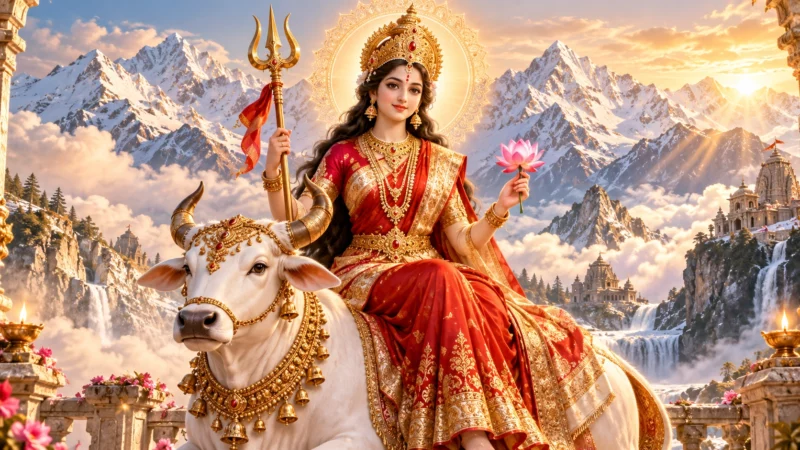
Shailputri means “daughter of the mountains.” She is the first of the nine forms of Goddess Durga and the goddess worshipped on the 1st day of Navratri. She is also known as Parvati, the consort of Lord Shiva.
Because she opens the nine nights, she is seen as the goddess of foundations, the one who gives every new effort a strong and steady start. This especially holds true for people entering a new stage of life like marriage or seeking a baby.
Why is Performing Maa Shailputri Puja Important?
Her worship on the first day of Navratri is believed to bring blessings across many areas of life, not just one. Here is what devotees seek from it.
-
Stability and a Strong Foundation
Shailputri is linked with the Muladhara, or root chakra, the seat of grounding and security. Devotees pray to her for steadiness in career, finances and home life.
This puja is especially sought when life feels uncertain. Worshipped with sincerity, she is believed to give not just a good start, but the patience to build on it.
-
Courage to Begin Something New
A new job, a new business, a new city, or a new chapter can feel unsettling. So, people traditionally worship Goddess Shailputri to seek the willpower to take that first step.
This puja is often chosen by those standing at a turning point. Shailputri Mata blessings are believed to replace hesitation with quiet confidence.
-
Peace of Mind and Emotional Balance
Shailputri is associated with the Moon, which in Vedic astrology governs the mind and emotions. Hence, her worship is traditionally linked with calm and clarity of thought.
Devotees who feel restless, anxious or overwhelmed turn to her for this reason. A sankalp on Day 1 is believed to help the mind settle for the nine days ahead.
-
Harmony in Family Life
A household begins on steady ground when its members feel supported. Starting Navratri with a family sankalp in the name of Maa Shailputri invites warmth and understanding into the home.
It is a meaningful way for the whole family to pray together. Moreover, people traditionally seek her blessings for protection and togetherness.
-
Blessings in Marriage Matters
Maa Shailputri is Parvati reborn, and her story is one of devotion leading to union. For this reason, many families pray to her when marriage plans feel delayed.
This is especially true for those facing repeated setbacks in finding a match. We explain separately why Navratri Day 1 is considered meaningful for this prayer.
-
Grounded, Positive Energy at Home
Navratri is considered a time when prayers carry special weight. Starting it with Maa Shailputri’s worship is believed to set a calm tone for the household.
Devotees feel this steady energy stays with them through all nine days. Devotees traditionally seek her blessings for a peaceful, positive home.
Why is Vivah Badha Nivaran Puja Especially Meaningful on Maa Shailputri Day?
Maa Shailputri is the goddess whose own story is about love, devotion and union. That is why many families choose Day 1 of Navratri to begin prayers for marriage and for the removal of hurdles in its path.
- Her Story is a Story of Union: Shailputri is Parvati reborn, whose steady devotion led to her union with Lord Shiva. So, praying for a happy marriage on her day is seen as turning to the one who knows that journey.
- Day 1 is the Day of Beginnings: As the first form of Durga, she opens the nine nights. A sankalp taken on this day is believed to set the intention for everything that follows, including a fresh start in matters of marriage.
- Patience Over Pressure: Delays in marriage can bring worry and self-doubt. Her energy of steadiness and grounding is traditionally sought to help families wait and pray with calm, rather than anxiety.
- Navratri is Considered an Auspicious Window: The nine nights are believed to be a time when prayers carry special weight, so a puja performed at the start is thought to be especially meaningful.
- A Companion to Your Day 1 Worship: Praying to Maa Shailputri at home and having a pandit perform the Vivah Badha Nivaran Puja in your name and gotra can work together as one intention for the season.
Who may consider it: Those facing repeated delays in finding a match or proposals that fall through at the last stage can book this puja. Also, families who simply wish to begin the marriage journey with blessings must also participate in it.
What is the Astrological Significance of Worshipping Maa Shailputri?
In Vedic astrology, each of the nine Navratri forms is traditionally linked with a planet. Maa Shailputri is associated with the Moon (Chandra), the planet of the mind, emotions and inner stability.
- Moon (Chandra): The Moon governs the mind, mood and sense of security. Devotees with a weak or afflicted Moon in their birth chart, often seen as restlessness, overthinking or emotional ups and downs, traditionally turn to Maa Shailputri for balance.
- Monday: Monday is ruled by the Moon, so it is considered a favourable day to remember her. If Navratri Day 1 falls on a Monday, many devotees see it as an especially fitting combination.
- Cancer (Karka Rashi): Cancer is ruled by the Moon. People of this sign, or those with the Moon placed strongly in their chart, often feel a natural pull towards her worship.
- Moon-ruled Nakshatras: Rohini, Hasta and Shravana are the three nakshatras ruled by the Moon. So, Devotees born under these stars often choose her puja to strengthen the Moon’s calming influence.
- Root Chakra (Muladhara): Linked with the earth element and the base of the spine, it stands for stability. Astrologers often connect this with the Moon’s role in emotional grounding.
Who May Benefit From Pleasing Maa Shailputri?
- Those with a weak or afflicted Moon, or those running a Chandra Mahadasha or Antardasha
- People facing mental stress, anxiety or disturbed sleep
- Those going through Sade Sati, when emotional steadiness is often sought (the Moon sign is the reference point for it)
- Families praying for peace in the home and a settled start to the year
Maa Shailputri Puja Samagri and Simple Vidhi
Samagri
Pure desi ghee (her traditional bhog), white flowers, white sweets or kheer, kumkum, akshat (rice), incense, a diya and a kalash filled with water.
Simple Vidhi
Bathe and wear clean clothes, set up the kalash and an image of Maa Shailputri, light a ghee lamp, offer white flowers and bhog, chant her mantra, and conclude with aarti. Share the prasad with your family.
Refer to Have It Performed for You?
If you are travelling, working long hours or living abroad, you can book a pandit-led puja with InstaAstro Puja Seva. The sankalp is taken in your name and gotra, and photos and full video of the puja are shared with you. Single, Couple, Family or VIP packages are available.
An Easy Shailputri Puja Mantra for Everyone
ॐ देवी शैलपुत्र्यै नमः
Om Devi Shailaputryai Namah
Meaning: “I bow to the Goddess Shailputri.”
Chanting the Maa Shailputri Mantra 108 times on day 1 of Navratri, in the morning and evening, or anytime you need focus, is traditionally said to invite stability and a calm mind. This is the easiest to follow, and hence, anyone can chant it.
Conclusion
Maa Shailputri is not a goddess who asks for grand gestures. She is the quiet foundation beneath every beginning, and her puja is simply the act of starting well, with faith and intention. Begin this Navratri with her blessings, and let the nine days that follow rest on firm ground. Jai Maa Shailputri!