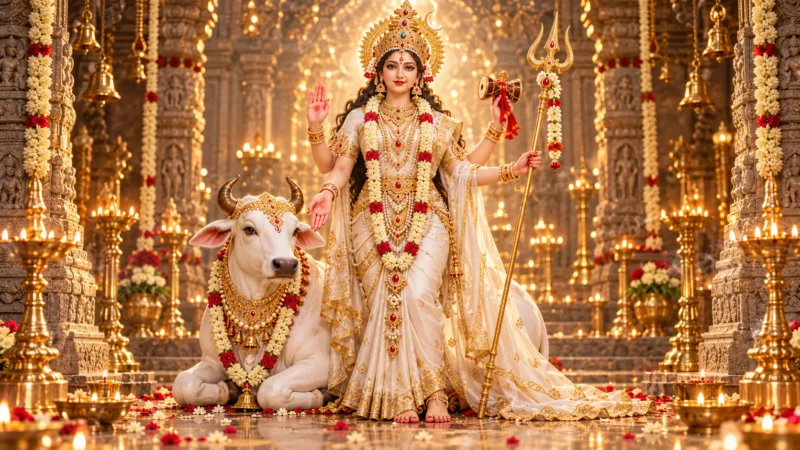
Dressed in white and glowing like the full moon, Mahagauri is the goddess devotees turn to on Ashtami when they want to wash away old sorrows and begin again with a clear heart. This is the peace you invite with Mahagauri Puja.
Also Read: The Powers Of Maa Baglamukhi
What Is Mahagauri Puja All About?
Suggested Puja
108 Chandi Kavach Path and Havan
Inner strength, courage & freedom from fear & negativity.
Mahagauri Puja is the worship of Maa Mahagauri, the eighth of the nine forms of Goddess Durga, on Day 8 of Navratri. The name joins Maha, meaning great, with Gauri, meaning fair and radiant.
Tradition describes her as fair as a conch, the moon and jasmine, dressed in white and riding a white bull. Her four arms hold a trishul and a damaru and offer the abhaya and varada mudras of fearlessness and blessing.
After her long penance, her skin had darkened. Lord Shiva bathed her with the waters of the Ganga, and she regained her brilliant glow, which is how she became Mahagauri. She blesses the Soma chakra, the subtle centre linked with calm and purity.
Why Does Ashtami Belong to Maa Mahagauri?
Devotees perform the puja on the eighth day of Navratri for these main reasons.
- She Follows Kalaratri: After the fierce protection of Day 7, Day 8 brings the calm and light that follow once fear has gone.
- The Day of Purity: The eighth day celebrates the goddess whose very form stands for cleansing and renewal.
- Maha Ashtami Tithi: Day 8 falls on Ashtami, which many regions observe as Maha Ashtami, the high point of Navratri.
- Rahu and Calm: Tradition associates her with Rahu, the shadow planet, and her serenity is said to settle its restless influence.
- Soma Chakra: Tradition links the Soma chakra with this day, which makes it a good time to pray for peace of mind.
- A Day for Kanya Pujan: Families honour young girls as living forms of the goddess on Ashtami, which makes this day especially significant.
Ashtami Kanya Pujan: How Does It Connect with Mahagauri Puja?
On Ashtami, and on Navami in some families, devotees welcome young girls into their homes as living forms of the goddess. Many families perform Mahagauri Puja in the morning and follow it with Kanya Pujan.
How Do Families Perform Kanya Pujan?
- Invite the Girls: Invite nine girls between the ages of two and ten. Many families also invite one young boy to represent Lord Bhairav.
- Wash Their Feet: Wash their feet with clean water and apply a tilak on the forehead.
- Serve the Prasad: Offer halwa, puri and black chana, the traditional Kanya Pujan meal.
- Give Gifts: Present fruits, a red chunri, bangles, stationery or other small gifts.
- Take Blessings: Touch their feet and bow with respect before they leave.
Why Does Kanya Pujan Go with Maa Mahagauri?
- Her Form is Pure and Youthful: Tradition describes Maa Mahagauri as the radiant, eight-year-old Gauri, so honouring young girls on her day feels natural.
- Ashtami is the Peak of the Fast: Many devotees break their Navratri fast with Kanya Pujan on this day.
- The Prasad Carries Blessings: Devotees believe the meal shared with the girls brings the goddess’s grace into the home.
What Are the Benefits of Mahagauri Puja?
Maa Mahagauri is the serene and gracious goddess who cleanses and blesses, so devotees turn to her for peace, purity and a fresh beginning. Tradition holds that her worship brings blessings in many areas, not just one.
Cleansing of Past Burdens and Sorrow
Her story of regaining her glow after hardship is why devotees pray to her for relief from old regrets and sorrow. Tradition associates her with washing away what weighs on the heart.
Those who carry the memory of past mistakes or losses often seek her blessings. Devotees believe her worship helps them move forward with a lighter mind.
Peace of Mind and Composure
Her moon-like glow stands for calm, and devotees pray to her when the mind feels restless or heavy. They associate her gentle presence with emotional steadiness.
People who struggle with worry or sleepless nights often choose this puja. Devotees believe a sankalp on Day 8 settles the mind through the closing days of Navratri.
Harmony in Marriage and Blessings for a Suitable Partner
Maa Mahagauri is the Gauri whose penance won Lord Shiva, so unmarried devotees traditionally pray to her for a good life partner. Married couples also seek her blessings for harmony.
Many families perform this puja together for a peaceful married life. Devotees believe her blessings strengthen understanding and trust between partners.
Fulfilment of Sincere Wishes
Devotees believe Maa Mahagauri grants the wishes of those who pray with a pure heart. Tradition calls her a giver of auspicious outcomes.
People hoping for a long-awaited result often choose this puja. Devotees believe her blessings reward sincere effort and faith.
Wellbeing and Prosperity for the Family
A calm, auspicious home is the foundation of a family’s growth, and devotees pray to Maa Mahagauri for exactly that. They believe her blessings bring harmony and steady progress.
Families often perform the puja together on Ashtami. Devotees believe the shared prayer invites peace and abundance into the household.
Purity of Mind and Spiritual Growth
Her white form stands for a mind cleansed of anger and anxiety. Devotees pray to her for clarity and a deeper connection with their practice.
Regular practitioners often seek her blessings in the last days of Navratri. Devotees believe her worship steadies their devotion and focus.
Who Should Perform Mahagauri Puja?
As a devotee, you may want to perform Mahagauri puja if you:
- Carry sorrow, regret or a heavy memory from the past
- Feel anxious, restless or low on peace of mind
- Are unmarried and wish to pray for a suitable life partner
- Want to bring harmony and understanding into your married life
- Have a weak or afflicted Rahu in your birth chart
- Want to pray for the well-being and prosperity of your family
- Plan to perform Kanya Pujan on Ashtami and want to begin it with a puja
What is the Astrological Link of Maa Mahagauri Puja?
In Vedic astrology, each Navratri form is traditionally linked with a planet. Tradition associates Maa Mahagauri with Rahu, the shadow planet of confusion, illusion and sudden change.
- Rahu: Rahu governs illusion, restlessness and unexpected turns. Devotees with a weak or afflicted Rahu, often seen as confusion, anxiety or sudden setbacks, traditionally turn to Maa Mahagauri.
- Moon (Chandra): Her white, moon-like glow links her with the Moon, the planet of the mind. Devotees seeking emotional calm often pray to her for this reason.
- Rahu-ruled Nakshatras: Ardra, Swati and Shatabhisha come under Rahu. There is no scripturally fixed nakshatra for Maa Mahagauri, but devotees born under these stars often choose her puja to steady Rahu’s influence.
- Ashtami Tithi: The eighth tithi is traditionally seen as a powerful day for prayer and renewal.
- Soma Chakra: Linked with calm and purity, it relates to peace of mind.
Who Can Perform Mahagauri Puja as a Remedy?
- Those with a weak or afflicted Rahu, or those running a Rahu Mahadasha or Antardasha
- People facing confusion, anxiety or sudden obstacles
- Those with Rahu-related doshas, including Kaal Sarp Dosha
- People who wish to cleanse their minds and begin again with peace
Mahagauri Puja Samagri and Vidhi: What You Need
You can perform the puja at home or follow along with a pandit. Either way, the right samagri and a calm, simple vidhi keep your prayer focused.
Samagri
Coconut (her traditional bhog), white flowers such as jasmine, kumkum, akshat (rice), incense, a diya, a japa mala, Gangajal, an image of Maa Mahagauri, and a kalash filled with water. For Kanya Pujan, keep halwa, puri and black chana ready.
Simple Vidhi
Bathe early and wear clean clothes, preferably in white or pink. Set up an image of Maa Mahagauri, sprinkle a little Gangajal, light a lamp, offer white flowers and a coconut, and chant her mantra with a mala. Pray with a clear sankalp, conclude with aarti, and then perform Kanya Pujan if your family follows it.
Popular and Powerful Maa Mahagauri Chants
Devotees recite these popular chants to please Maa Mahagauri. These chants make Mahagauri Puja even more effective.
Maa Mahagauri Mantra
ॐ देवी महागौर्यै नमः॥
Om Devi Mahagauryai Namah॥
Maa Mahagauri Stuti
या देवी सर्वभूतेषु माँ महागौरी रूपेण संस्थिता।
नमस्तस्यै नमस्तस्यै नमस्तस्यै नमो नमः॥
Ya Devi Sarvabhuteshu Maa Mahagauri Rupena Samsthita।
Namastasyai Namastasyai Namastasyai Namo Namah॥
Maa Mahagauri Prarthana
श्वेते वृषे समारूढा श्वेताम्बरधरा शुचिः।
महागौरी शुभं दद्यान्महादेवप्रमोददा॥
Shvete Vrishe Samarudha Shvetambaradhara Shuchih।
Mahagauri Shubham Dadyanmahadevapramododa॥
Mantra for Auspiciousness and Fulfilment
सर्वमङ्गलमाङ्गल्ये शिवे सर्वार्थसाधिके।
शरण्ये त्र्यम्बके गौरि नारायणि नमोऽस्तु ते॥
Sarvamangalamangalye Shive Sarvarthasadhike।
Sharanye Tryambake Gauri Narayani Namostu Te॥
Maa Mahagauri Dhyana
वन्दे वाञ्छित कामार्थे चन्द्रार्धकृतशेखराम्।
सिंहारूढ़ा चतुर्भुजा महागौरी यशस्विनीम्॥
पूर्णेन्दुनिभां गौरी सोमचक्रस्थितां अष्टमं दुर्गा त्रिनेत्राम्।
वराभीतिकरां त्रिशूलडमरूधरां महागौरीं भजेम्॥
Vande Vanchhita Kamartham Chandrardhakritashekharam।
Simharudha Chaturbhuja Mahagauri Yashasvinim॥
Purnendunibham Gauri Somachakrasthitam Ashtamam Durga Trinetram।
Varabhitikaram Trishuladamarudharam Mahagaurim Bhajem॥
Conclusion
Maa Mahagauri shows that patience and faith can restore even the deepest glow. The same goddess who emerged radiant after her long penance blesses her devotees with calm, purity and a fresh start. Make the eighth day of Navratri a day of gentle renewal, and let her blessings clear your path. Jai Maa Mahagauri!